4×4 Land Cruiser with 2 Rooftop Tents for 4 People Rental in Arusha
The complete guide to renting a fully equipped camping Land Cruiser in Arusha for a family or group self-drive safari through Tarangire, Lake Manyara, Ngorongoro and the Serengeti
| Quick Facts at a Glance
Vehicle: Toyota Land Cruiser 76/78 Station Wagon or 79 Double Cab, 4.2L or 4.5L diesel, full-time or part-time 4WD Sleeping: Two rooftop tents, each sleeping two adults (4 people total) Pick-up points: Arusha city, Kilimanjaro International Airport (JRO), Arusha Airport (ARK) or your hotel Indicative price: US$170 to US$260 per day, fully equipped, depending on season and rental length Best for: Families, groups of friends and two couples on a northern circuit camping safari Minimum rental: Usually 3 days; 5+ days recommended for the northern circuit |
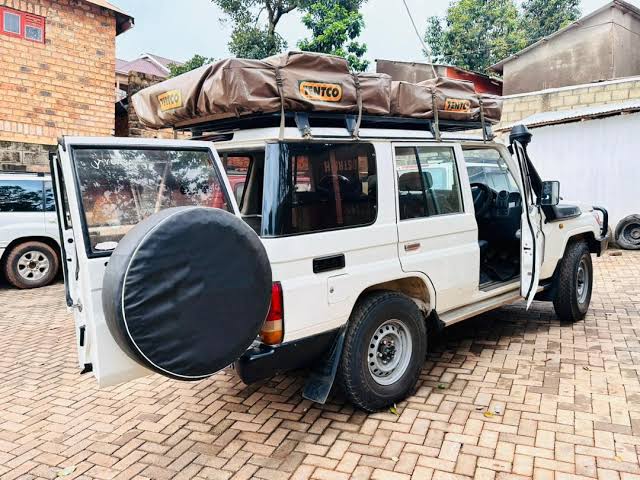
Why a Land Cruiser with Two Rooftop Tents?
Arusha is the gateway to Tanzania’s famous northern safari circuit. Within a few hours of the city lie Tarangire’s baobab-studded plains, the tree-lined shores of Lake Manyara, the vast caldera of the Ngorongoro Crater and the endless grasslands of the Serengeti. For a group of four travelers who want freedom, adventure and value, there is no better way to explore this region than behind the wheel of a 4×4 Toyota Land Cruiser fitted with two rooftop tents.
This setup turns one vehicle into a complete mobile safari camp. Two couples, a family of four or a group of friends can drive from park to park at their own pace, pitch camp in minutes on top of the vehicle and wake up to the sounds of the African bush, all without paying for four lodge beds every night. Compared with a guided lodge safari, a self-drive camping safari in a Land Cruiser can cut accommodation costs dramatically while giving you a far more intimate wilderness experience.
This guide covers everything you need to know before you book: the vehicles available, what comes in the camping package, realistic pricing, park and camping fees, the best routes and campsites from Arusha, a sample 7-day itinerary, rental requirements, driving tips and answers to the most common questions.
Why the Toyota Land Cruiser Is the Ultimate Safari Vehicle
The Land Cruiser is the undisputed workhorse of East African safaris. Tour operators, park rangers, researchers and conservation teams across Tanzania rely on it for good reason, and when you are carrying four people plus two rooftop tents and a week of camping gear, those strengths matter more than ever.
- Proven toughness: Built on a heavy-duty ladder chassis with solid axles, it handles the corrugated Serengeti roads, rocky crater descents and muddy black-cotton soil with ease.
- Load capacity: Two rooftop tents typically weigh 60 to 75 kg each. The Land Cruiser’s roof rack and suspension carry this weight safely, along with passengers, water, fuel and luggage.
- Long roof: The extended-body 76 and 78 station wagons and the 79 double cab have enough roof and rack length to mount two full-size tents side by side or front and back.
- Ground clearance: Roughly 230 mm of clearance helps you cross dry riverbeds, washed-out tracks and rough campsite approaches.
- Parts and mechanics everywhere: If something breaks, Land Cruiser parts and skilled mechanics are available in Arusha, Karatu, Mto wa Mbu and even near Seronera in the Serengeti.
- Range: Factory long-range tanks (often 130 to 180 litres combined) let you cover long distances between fuel stations, which is vital in the Serengeti.
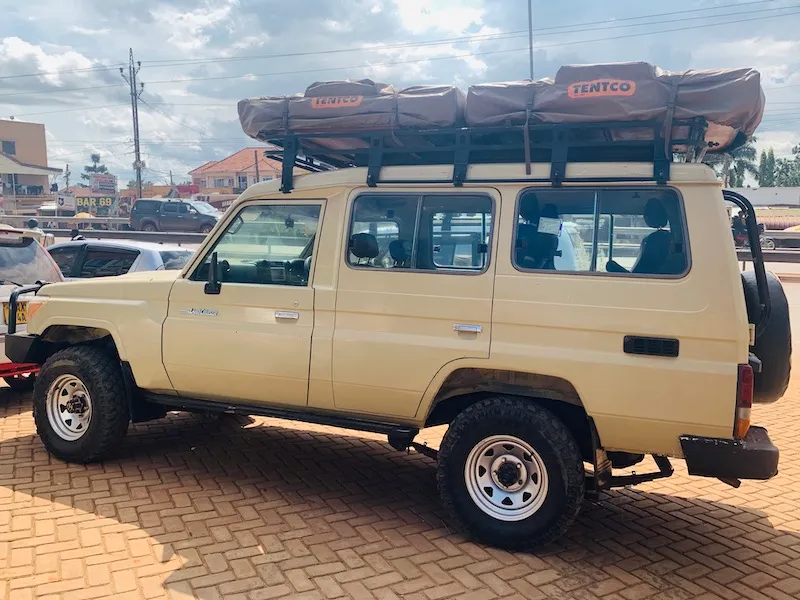
Land Cruiser Models Available for 4-Person Rooftop Camping
Not every Land Cruiser is suited to carrying two rooftop tents and four people. Arusha rental fleets usually offer the following configurations:
| Model | Seats | Tent Mounting | Best For |
| Land Cruiser 76 Station Wagon | 5 | Two tents on full-length roof rack | Families and groups wanting enclosed luggage space |
| Land Cruiser 78 (Troop Carrier) | 5 to 8 | Two tents on long roof; huge rear cargo area | Groups carrying lots of gear and water |
| Land Cruiser 79 Double Cab | 5 | One tent over cab, one over load bed/canopy | Rugged overlanding with separate gear storage |
| Land Cruiser 105 / 200 Series | 5 to 7 | Two compact tents on heavy rack | Travellers wanting more on-road comfort |
| Land Cruiser Safari Pop-Up (converted) | 6 to 7 | Two tents on rack; pop-up roof for game viewing | Groups wanting game-viewing hatch plus camping |
Typical Specifications
| Feature | Typical Specification |
| Engine | 4.2L 1HZ or 1HD diesel, or 4.5L V8 1VD diesel |
| Drivetrain | Part-time 4WD with low-range transfer case; diff locks on many units |
| Transmission | 5-speed manual (most common); automatic on 200 Series |
| Fuel capacity | 90 to 180 litres (main plus auxiliary tank) |
| Fuel economy | Roughly 6 to 8 km per litre fully loaded off-road |
| Ground clearance | Approximately 230 to 240 mm |
| Rooftop tents | Two hard-shell or soft-shell tents, each about 1.4 m x 2.4 m when open |
| Extras | Dual-battery system, fridge, water tank, two spare tyres, recovery gear |
| Tip: Confirm the Seating Layout
Some converted Land Cruisers lose rear seats to make room for fridges, drawers and water tanks. When booking for four people, ask the rental company to confirm four proper seats with seatbelts plus secure storage for camping gear. |
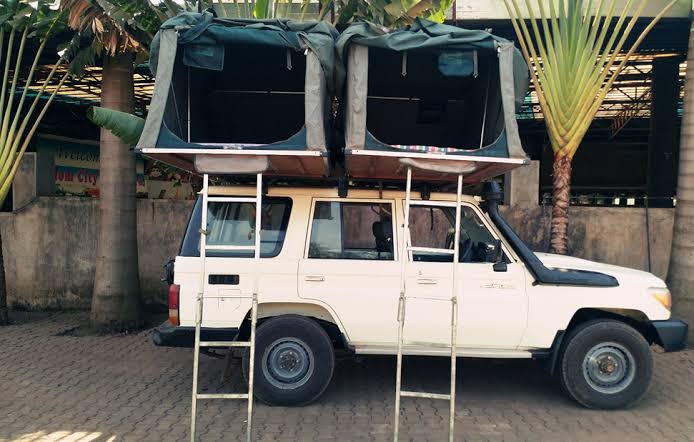
Understanding the Two Rooftop Tents
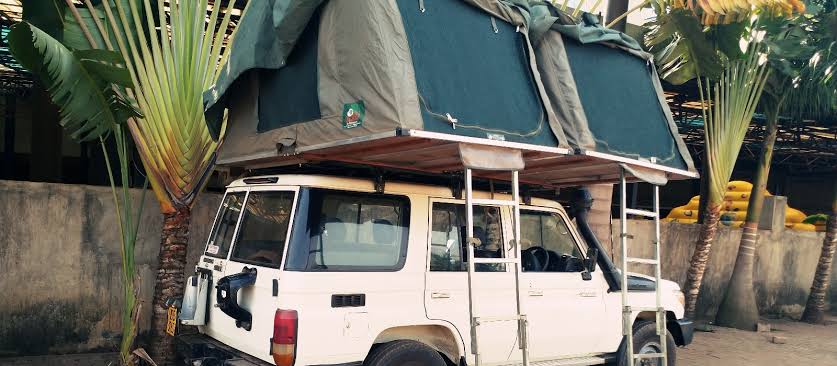
Each rooftop tent is designed to sleep two adults comfortably on a built-in high-density foam mattress, accessed by an aluminium telescopic ladder. Sleeping off the ground keeps you away from damp soil, insects and curious wildlife, and gives you a fantastic view from your tent window.
Hard-Shell vs Soft-Shell Tents
| Feature | Hard-Shell Tent | Soft-Shell (Fold-Out) Tent |
| Set-up time | 1 to 2 minutes | 5 to 10 minutes |
| Interior space | Slightly smaller | Larger, often with an annex option |
| Weather resistance | Excellent in wind and heavy rain | Good, but flaps more in strong wind |
| Weight | Heavier (65 to 80 kg) | Lighter (50 to 65 kg) |
| Fuel impact | Better aerodynamics | More drag when closed |
Sleeping Arrangements for Four
- Two couples: One couple per tent; the most popular arrangement.
- Family with two children: One parent with each child, or both children in one tent. Children under about 6 may need supervision on the ladder.
- Four friends: Two per tent; each tent fits two adults with sleeping bags side by side.
- Optional ground tent: Many companies add a ground tent on request if someone prefers more space or headroom.
What’s Included in a Typical Rental Package
A fully equipped 4-person camping Land Cruiser from Arusha usually comes with everything you need to camp independently. Exact inclusions vary by company, so always request a written gear list.
Vehicle Inclusions
- Comprehensive insurance (with an excess or deductible)
- Unlimited or high daily mileage allowance
- Two spare tyres, high-lift jack, wheel spanner and puncture repair kit
- Recovery gear: tow strap, shovel and sand tracks
- Dual-battery system with inverter and USB charging
- 12V/220V portable fridge-freezer (40 to 60 litres)
- Water tank (40 to 80 litres) plus jerrycans
- First-aid kit, fire extinguisher and warning triangles (required by Tanzanian law)
- Tanzania road map, GPS or offline maps, and a local SIM card on request
- 24/7 roadside assistance
Camping Equipment for 4 People
| Category | Items Provided |
| Sleeping | 2 rooftop tents with mattresses, 4 sleeping bags, 4 pillows, sheets or liners |
| Furniture | Folding camping table, 4 camping chairs |
| Cooking | 2-burner gas stove, gas cylinder, pots, frying pan, kettle, braai grid |
| Dining | 4 sets of plates, bowls, mugs, cutlery and glasses |
| Kitchen extras | Chopping board, knives, can opener, washing basin, cool box |
| Lighting | LED camp lights, headlamps or torches |
| Other | Awning (on many vehicles), cleaning materials, rubbish bags, mosquito nets |
How Much Does It Cost? Rental Prices in Arusha
Prices for a 4×4 Land Cruiser with two rooftop tents in Arusha depend on the model, its age, the season and how long you rent. The figures below are indicative and in US dollars; always request a written quote.
| Rental Length | Low Season (per day) | High Season (per day) | Notes |
| 3 to 6 days | US$200 to US$260 | US$230 to US$280 | Short-rental premium applies |
| 7 to 13 days | US$180 to US$230 | US$210 to US$250 | Most popular range |
| 14 to 20 days | US$170 to US$210 | US$190 to US$230 | Discount for longer trips |
| 21+ days | US$160 to US$190 | US$180 to US$220 | Best value; negotiate |
High season usually means late June to October plus the Christmas and New Year period. Low season typically covers the long rains from April to May, while November and January to March sit in between.
Common Optional Extras
| Extra | Typical Cost |
| Additional driver | US$5 to US$10 per day, or free with some companies |
| Airport delivery/collection (JRO) | US$30 to US$60 each way |
| Third ground tent | US$10 to US$15 per day |
| Satellite phone or Wi-Fi router | US$8 to US$15 per day |
| Excess reduction (super cover) | US$10 to US$25 per day |
| Cross-border permit (Kenya, Rwanda, Uganda) | US$100 to US$250 one-off, plus border fees |
| One-way drop-off (Dar es Salaam, Nairobi, Kampala) | Quoted per route |
Sample Budget: 7-Day Northern Circuit for 4 People
A rough estimate to help you plan. Park fees change, so check current TANAPA and NCAA rates before you travel.
| Cost Item | Estimated Total (USD) |
| Land Cruiser + 2 rooftop tents, 7 days | 1,400 to 1,750 |
| Fuel (approx. 1,100 km) | 300 to 400 |
| Park entry fees, 4 non-resident adults | 2,200 to 2,900 |
| Ngorongoro Crater vehicle service fee | About 295 per descent |
| Public campsite fees | 550 to 800 |
| Food, water and supplies | 300 to 450 |
| Estimated total for 4 people | 5,000 to 6,600 (about 1,250 to 1,650 per person) |
| Cost Comparison
A comparable 7-day guided lodge safari for four people in northern Tanzania commonly runs to US$2,500 to US$4,500 or more per person. A self-drive camping safari offers serious savings, especially for groups who split the vehicle and fuel cost four ways. |
Park Entry, Vehicle and Camping Fees
Tanzania’s northern parks are managed by Tanzania National Parks (TANAPA), while the Ngorongoro Conservation Area is managed by the Ngorongoro Conservation Area Authority (NCAA). Fees are paid electronically by card or through the government e-payment system at the gate; cash is generally not accepted. The figures below are approximate per-person, per-24-hour non-resident rates including VAT and should be verified before travel.
| Park / Area | Adult Entry (approx.) | Public Camping (approx.) |
| Serengeti National Park | US$83 per 24 hours | US$35 to US$60 per night |
| Ngorongoro Conservation Area | US$71 per 24 hours | US$35 to US$60 per night (Simba Camp) |
| Ngorongoro Crater descent | Vehicle service fee approx. US$295 | No camping in crater |
| Tarangire National Park | US$59 per 24 hours | US$35 per night |
| Lake Manyara National Park | US$59 per 24 hours | US$35 per night |
| Arusha National Park | US$53 per 24 hours | US$35 per night |
| Important Fee Notes
Vehicle fees: A Tanzania-registered rental vehicle pays a much lower daily vehicle fee than a foreign-registered one, which is another advantage of renting in Arusha. Children: Discounted rates apply for children aged 5 to 15; children under 5 usually enter free. 24-hour rule: Fees are charged per 24-hour period from your entry time. Plan entry and exit times carefully to avoid paying for an extra day. Transit: Driving through Ngorongoro to reach the Serengeti still requires paying Ngorongoro conservation fees. |
Pick-Up and Drop-Off Locations
Most Arusha rental companies offer flexible collection and return options:
- Arusha city depot: The standard location, where you get a full handover and vehicle briefing.
- Kilimanjaro International Airport (JRO): About 50 km (roughly 1 hour) east of Arusha; ideal if you fly in internationally.
- Arusha Airport (ARK): Convenient for domestic connections, including flights from Zanzibar and Dar es Salaam.
- Your hotel or lodge: Free or low-cost delivery within Arusha town with many companies.
- Moshi and Karatu: Available on request for an additional delivery fee.
Allow at least 1.5 to 2 hours for the vehicle handover. The team should show you how to open and close both rooftop tents, operate the fridge and dual batteries, engage 4WD and low range, change a tyre and use the recovery gear. Take photos and video of the vehicle’s condition before you leave.
Best Routes and Destinations from Arusha
A Land Cruiser with two rooftop tents opens up the entire northern circuit. These are the classic stops and the approximate driving times from Arusha.
| Destination | Distance from Arusha | Drive Time | Highlights |
| Arusha National Park | 25 to 35 km | 45 min to 1 hr | Mount Meru, Momella Lakes, colobus monkeys, giraffes |
| Tarangire National Park | 120 km | 2 hrs | Huge elephant herds, baobabs, Tarangire River |
| Lake Manyara National Park | 125 km | 2 hrs | Flamingos, tree-dwelling lions, groundwater forest |
| Ngorongoro Crater | 180 km | 3.5 to 4 hrs | Big Five in a collapsed caldera, black rhino |
| Serengeti (Seronera) | 325 km | 7 to 8 hrs | Great Migration, big cats, endless plains |
| Lake Natron | 240 km | 5 to 6 hrs | Lesser flamingos, Ol Doinyo Lengai, waterfalls |
Recommended Campsites for Rooftop Tents
| Area | Campsite | What to Expect |
| Arusha | Meserani Snake Park, Masai Camp | Hot showers, secure parking, good first or last night |
| Tarangire | Tarangire public campsite | Basic facilities, elephants nearby |
| Mto wa Mbu / Manyara | Twiga Campsite, Panorama Safari Camp | Showers, restaurants, close to Manyara gate |
| Karatu | Kudu Lodge & Campsite, Bougainvillea | Comfortable town campsites, great for supplies |
| Ngorongoro rim | Simba A Public Campsite | Crater rim views, cold nights, wild visitors |
| Central Serengeti | Seronera public campsites (Pimbi, Nyani, Tumbili, Dik Dik and others) | Unfenced, abundant wildlife, basic ablutions |
| Northern / Western Serengeti | Lobo, Ndabaka and special campsites | Migration areas; special campsites need advance booking |
Sample 7-Day Northern Circuit Self-Drive Itinerary
This route is designed for a group of four in a Land Cruiser with two rooftop tents, balancing driving time with plenty of game viewing.
Day 1: Arusha to Tarangire National Park
Collect your vehicle in the morning and complete the handover. Stock up on food, drinking water and supplies at a supermarket in Arusha, then drive about 2 hours to Tarangire. Spend the afternoon on a game drive along the Tarangire River, watching elephants and baobabs. Pitch both rooftop tents at the public campsite before sunset.
Day 2: Tarangire to Lake Manyara
Enjoy a sunrise game drive in Tarangire, then head to Mto wa Mbu (about 1.5 hours). In the afternoon, explore Lake Manyara National Park for flamingos, baboon troops and the famous tree-climbing lions. Camp at Twiga Campsite with hot showers.
Day 3: Lake Manyara to Serengeti
Start early. Drive up to the Ngorongoro highlands, pass the crater rim viewpoint and continue across the plains via Naabi Hill Gate into the Serengeti. Game drive en route to Seronera and set up camp at a public campsite in the heart of the park.
Day 4: Full Day in Central Serengeti
Spend the whole day exploring the Seronera River Valley, a hotspot for lions, leopards and cheetahs. Return to camp for lunch or pack a picnic. Evening around the camp table under a sky full of stars.
Day 5: Serengeti to Ngorongoro Crater Rim
Morning game drive, then drive back to the Ngorongoro Conservation Area. Pitch your tents at Simba Campsite on the crater rim and prepare for a cold night, as temperatures can drop below 10°C.
Day 6: Ngorongoro Crater to Karatu
Descend into the crater at first light for a half-day game drive in search of the Big Five, including rare black rhino. Ascend by midday and drive to Karatu for a comfortable campsite night with hot showers and a restaurant.
Day 7: Karatu to Arusha
Optional morning visit to a coffee farm or local market in Karatu, then drive about 3 hours back to Arusha. Return the vehicle cleaned of rubbish, refuel to the agreed level and check out.
| Extend Your Trip
Add 2 to 3 extra days to follow the Great Migration in the northern Serengeti (July to October) or the southern Ndutu plains during calving season (January to March). You can also add Lake Natron or Arusha National Park as a short first-day warm-up. |
Best Time to Rent a Rooftop Tent Land Cruiser in Arusha
| Period | Conditions | Camping Experience |
| June to October | Dry season, cool nights, excellent game viewing | Ideal for rooftop camping; busiest and highest prices |
| November to December | Short rains, green landscapes | Good camping with occasional afternoon showers |
| January to March | Warm, mostly dry; calving season in Ndutu | Excellent; superb predator action in the south Serengeti |
| April to May | Long rains, muddy roads | Challenging; 4WD essential, lowest prices, fewer crowds |
Rental Requirements
To rent a 4×4 Land Cruiser in Arusha, drivers typically need the following:
- Minimum age: Usually 23 or 25 years, with some companies requiring 25 for Land Cruisers.
- Driving experience: At least 2 to 3 years with a full licence.
- Valid driving licence: A licence in English is generally accepted. An International Driving Permit (IDP) is strongly recommended and may be requested at police checkpoints.
- Passport: Valid for at least six months, with a Tanzanian visa or e-visa where required.
- Security deposit: Commonly US$500 to US$2,000, held by card or paid in cash and refunded on return.
- Booking deposit: Usually 20 to 50 percent to confirm, with the balance due before or at pick-up.
- Additional drivers: Must be registered on the rental agreement with their licences shown at handover.
Driving Tips for Northern Tanzania
- Drive on the left: Tanzania drives on the left-hand side of the road.
- Respect speed limits: Typically 50 km/h in towns and villages and 80 km/h on open highways, but watch for signs and speed bumps. In national parks, the limit is usually 50 km/h or lower.
- Police checkpoints: Common on main roads. Stay polite, carry your licence, IDP, passport and rental documents, and ensure your fire extinguisher and warning triangles are on board.
- Avoid night driving: Livestock, pedestrians, unlit vehicles and wildlife make driving after dark dangerous. In parks, game drives are generally restricted to daylight hours, roughly 6 am to 6:30 pm.
- Fuel up often: Fill up in Arusha, Mto wa Mbu or Karatu. Fuel is available near Seronera but is more expensive and occasionally limited.
- Mind the load: With two rooftop tents, the vehicle’s centre of gravity is higher. Take corners slowly, reduce speed on corrugated roads and avoid sharp swerves.
- Tyre pressure: Ask the rental team about recommended pressures for gravel versus tarmac.
- Stay on designated tracks: Off-road driving is prohibited in most areas of Tanzania’s national parks and attracts heavy fines.
Camping Safety Tips
- Pitch your tents before dark and keep the area around the vehicle clear.
- Never leave food, rubbish or cool boxes outside. Hyenas, baboons and honey badgers are notorious camp raiders.
- Use the ladder carefully at night with a headlamp, and look around before climbing down.
- Keep the vehicle keys in a known, accessible place in case you need to move quickly.
- If you need the bathroom at night in an unfenced campsite, scan with a torch first, or plan ahead with a portable toilet if available.
- Follow ranger instructions at all times and keep a safe distance from wildlife.
- Close both tents fully during the day to keep out dust, insects and rain.
Packing Checklist for Four People
| Category | What to Bring |
| Clothing | Neutral-coloured layers, warm fleece and jacket for Ngorongoro, hat, sturdy shoes, sandals |
| Sleep comfort | Earplugs, eye mask, travel pillow (if preferred), extra blanket for cold nights |
| Health | Malaria prophylaxis (consult a doctor), insect repellent, sunscreen, personal medications, hand sanitiser |
| Documents | Passports, visas, licences, IDP, yellow fever certificate (if arriving from an endemic country), travel insurance |
| Electronics | Binoculars, camera with zoom lens, power bank, 12V car chargers, spare batteries |
| Food and water | Drinking water (about 4 litres per person per day), easy meals, snacks, coffee and tea |
| Extras | Cash in Tanzanian shillings for small purchases, wet wipes, toilet paper, reusable bags |
How to Book Your Land Cruiser in Arusha
- Choose your dates and route: Decide how many days you need and which parks you plan to visit.
- Request quotes: Ask at least two or three reputable companies for written quotes with full inclusions.
- Check the details: Confirm the vehicle model, year, seating for four, tent type, insurance excess and mileage policy.
- Read the contract: Pay attention to cancellation terms, damage policy, cross-border rules and breakdown procedures.
- Pay the deposit: Secure your booking, especially for June to October.
- Book special campsites: If you plan to use special (private) campsites in the Serengeti, these must be booked in advance.
- Collect and inspect: Complete the handover, test all equipment and set off on your adventure.
Frequently Asked Questions
Can four adults really sleep comfortably in two rooftop tents?
Yes. Each rooftop tent is designed for two adults, with a mattress roughly the size of a double bed. Four adults sleep comfortably, two per tent.
Do I need off-road driving experience?
Not necessarily. Most northern circuit roads are gravel or tarmac, and the main challenge is corrugations and occasional mud. The rental team will brief you on engaging 4WD and low range. Some off-road confidence helps during the rainy season.
Is it safe to camp in the Serengeti?
Camping in designated public and special campsites is a well-established practice. Sleeping in a rooftop tent adds an extra layer of safety. Follow ranger guidance, keep food locked away and avoid wandering at night.
How long does it take to set up the two rooftop tents?
Hard-shell tents take 1 to 2 minutes each; soft-shell tents take around 5 to 10 minutes. With practice, a group of four can set up camp in under 15 minutes.
Can I take the Land Cruiser across the border?
Many Arusha companies allow cross-border travel to Kenya, Rwanda and Uganda with prior approval, a cross-border permit, COMESA insurance and the correct documents. Always arrange this at the time of booking.
Can we hire a driver-guide instead?
Yes. Most companies can supply a driver-guide for an additional daily fee. Note that a driver-guide will need his own accommodation or a third tent.
Is fuel included in the price?
No. Fuel is normally your responsibility. The vehicle is usually supplied with a full tank and should be returned full.
What happens if the vehicle breaks down?
Reputable companies provide 24/7 roadside assistance and will send a mechanic or replacement vehicle. Save the emergency number in every phone in your group.
Can we camp inside the Ngorongoro Crater?
No. Camping is only permitted on the crater rim, mainly at Simba Campsite. The crater floor is open for game drives during daylight hours.
Conclusion
Renting a 4×4 Land Cruiser with two rooftop tents in Arusha is one of the most rewarding ways for four people to experience Tanzania’s northern safari circuit. You gain the freedom to set your own schedule, the comfort of sleeping above the ground in the heart of the wilderness and the cost savings of a shared vehicle and campsite accommodation. Whether you are chasing the Great Migration across the Serengeti, watching elephants under Tarangire’s baobabs or descending into the Ngorongoro Crater at dawn, a fully equipped Land Cruiser makes every day an adventure.
| Ready to Start Your Tanzania Adventure?
Contact our team to check availability, request a tailored quote and reserve a fully equipped 4×4 Land Cruiser with two rooftop tents for your group of four. We are happy to help you plan routes, book campsites and prepare for an unforgettable self-drive safari from Arusha. |