Common Mistakes to Avoid When Self-Driving in Tanzania
24 costly errors first-time self-drivers make on Tanzania’s roads and in its national parks — and exactly how to avoid them
Common Mistakes to Avoid When Self-Driving in Tanzania, A self-drive safari in Tanzania is one of the most rewarding ways to experience East Africa. You set your own pace, linger at a lion sighting for as long as you like, and wake up at a Serengeti campsite with no tour group to answer to. But Tanzania is not a place to “wing it.” Distances are huge, park rules are strictly enforced, fees are paid in specific ways, and road conditions can change overnight when the rains arrive.
Most self-drive problems in Tanzania are not caused by bad luck. They come from a handful of predictable, avoidable mistakes: picking the wrong vehicle, misjudging drive times, mistiming a 24-hour park permit, carrying cash when the gate only takes cards, or ignoring the small print in a rental contract. This guide walks through the most common of those mistakes — grouped into planning, on-the-road, inside-the-parks and practical categories — and gives you a clear fix for each one.
| Who this guide is for
First-time visitors planning a self-drive safari on the northern circuit (Arusha, Tarangire, Lake Manyara, Ngorongoro, Serengeti) or the southern circuit (Mikumi, Ruaha, Nyerere). Travellers renting a 4×4 in Arusha, Dar es Salaam, Moshi or Iringa, including those with a rooftop tent or ground-camping setup. Overlanders crossing into Tanzania from Uganda, Kenya or Rwanda. |
The Top 10 Mistakes at a Glance
Short on time? These are the ten errors that cause the most wasted money, lost game-viewing time and stress for self-drivers in Tanzania. Each one is covered in detail below.
| Mistake | What it costs you | Quick fix |
| Renting a 2WD or small SUV for the parks | Getting stuck, damage charges, restricted routes | Rent a proper high-clearance 4×4 (Land Cruiser, Prado, Hilux) |
| Trusting Google Maps drive times | Arriving after dark, missing gate closing | Add 30–50% to estimates; plan 250–300 km max per day on mixed roads |
| Mistiming 24-hour park permits | Paying an extra full day of fees | Plan entry and exit times before you arrive at the gate |
| Bringing cash for park fees | Being unable to enter the park | Carry two working Visa/Mastercard cards |
| Speeding through villages | Frequent fines and police delays | Watch for 50 km/h signs; slow down at every settlement |
| Driving at night | Accidents with livestock, pedestrians, unlit trucks | Be parked at camp or lodge before dark |
| Letting the fuel tank run low | Stranded far from any station | Refill at every major town; carry a jerrycan where allowed |
| Skipping the pickup inspection | Being charged for pre-existing damage | Photograph and video the vehicle; check spares and jack |
| Not reading the insurance exclusions | Paying in full for tyres, glass or water damage | Ask what is excluded and what the excess is, in writing |
| Going off-road in the parks | Heavy fines and possible ejection | Stay on designated tracks at all times |
Part 1: Planning and Booking Mistakes
Many self-drive problems are locked in before you ever turn the ignition. Getting the planning stage right removes most of the risk from the rest of your trip.
Mistake 1: Choosing the Wrong Vehicle
The mistake
Booking the cheapest car on the list — a saloon, a small 2WD SUV or a “soft-roader” — on the assumption that the main roads are tarmac so any car will do.
Why it matters
The tarmac usually ends where the safari begins. The road from Ngorongoro’s Lodoare Gate to the Serengeti is long, corrugated gravel; internal park tracks can turn into deep mud or black cotton soil after rain; and the Ngorongoro Crater descent and ascent roads are steep and rough. Low-clearance vehicles bottom out, blow tyres and get stuck. Some rental companies also prohibit certain vehicles from entering specific parks, which can void your insurance if you ignore it.
How to avoid it
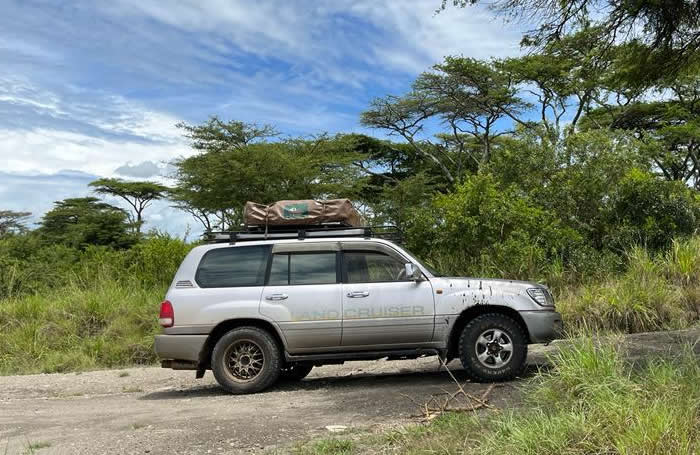
- For the northern circuit parks, choose a genuine high-clearance 4×4 with low-range gearing — Toyota Land Cruiser (Prado, 76/78/79 series) or Toyota Hilux double cab are the workhorses.
- A RAV4-class vehicle can work for Arusha, Tarangire and Lake Manyara in the dry season, but is a compromise for the Serengeti and the crater.
- If camping, confirm whether you need a rooftop tent (quick setup, off the ground) or a ground tent (cheaper, more space) and that all camping gear is listed in the contract.
- Tell your rental company your exact route so they can confirm the vehicle is permitted and suitable.
Mistake 2: Underestimating Distances and Drive Times
The mistake
Planning the route by looking at the map or Google Maps estimates and assuming you can cover 400–500 km in a day, then squeezing in a game drive on arrival.
Why it matters
Tanzania is a big country and average speeds are far lower than in Europe or North America. Speed bumps in every village, police checkpoints, slow trucks on hills, livestock crossings and gravel sections all eat into your time. Park gates close at a fixed time in the evening, and arriving late can mean being turned away or fined.
How to avoid it
- Add 30–50% to any online drive-time estimate, more in the rainy season.
- On mixed tarmac and gravel, plan for no more than 250–300 km per day if you also want to game-drive.
- Treat long transfer days (e.g., Arusha to central Serengeti) as travel days, with game viewing as a bonus en route.
- Always set off early — ideally at first light.
| Route | Approx. distance | Realistic drive time |
| Arusha → Tarangire (main gate) | ~120 km | 2 – 2.5 hrs |
| Arusha → Karatu / Lodoare Gate (Ngorongoro) | ~150 km | 2.5 – 3 hrs |
| Lodoare Gate → Seronera (central Serengeti) | ~140 km | 4 – 5 hrs (gravel, crater rim) |
| Arusha → Seronera (full transfer) | ~325 km | 7 – 9 hrs |
| Dar es Salaam → Mikumi | ~290 km | 5 – 6 hrs |
| Iringa → Ruaha National Park | ~120 km | 3 – 3.5 hrs (gravel) |
| Dar es Salaam → Arusha | ~630 km | 10 – 12 hrs (split over two days) |
| Tip
Distances and times are approximate and change with road works, weather and traffic. Use them for planning, then confirm locally before each long drive. |
Mistake 3: Ignoring the Seasons
The mistake
Booking a self-drive during the rainy months with the same vehicle, route and timetable you would use in the dry season.
Why it matters
Tanzania has two rainy seasons: the long rains (roughly March to May) and the short rains (roughly November to December). During heavy rains, black cotton soil in parts of the Serengeti, Tarangire and the southern parks becomes almost impassable, river crossings rise, and some remote tracks close. The flip side is fewer crowds and lower accommodation rates — if you plan for it.
How to avoid it
- If travelling in the wet season, rent a proper 4×4 with good all-terrain or mud tyres, recovery gear (shovel, tow strap, sand ladders) and a high-lift or bottle jack.
- Build extra buffer time into every drive day and avoid planning tight connections.
- Ask park rangers at the gate which tracks are open before heading into remote areas.
- For wildlife timing, match your route to the season: e.g., the southern Serengeti/Ndutu area for the calving season (around January to March), and the northern Serengeti for river crossings (roughly July to October).
Mistake 4: Not Reading the Rental Agreement and Insurance Small Print
The mistake
Signing the contract at the counter without reading it, assuming “fully insured” means you will pay nothing if something goes wrong.
Why it matters
Most Tanzanian rental insurance carries an excess (the amount you pay before insurance kicks in) and a list of exclusions. Common exclusions include tyres, windscreens and glass, the undercarriage, water damage from river crossings, damage caused while driving off-road or at night, and damage when an unauthorised driver was at the wheel. Unlimited-mileage assumptions can also catch people out.
How to avoid it
- Ask for the excess amount in writing and whether an excess-reduction option is available.
- Get a clear list of exclusions — especially tyres, glass, undercarriage and water damage.
- Confirm the mileage policy (limited or unlimited) and any per-kilometre charges.
- Register every driver on the agreement.
- Confirm what happens if the vehicle breaks down: who pays for recovery, and whether a replacement vehicle is provided.
Mistake 5: Skipping a Proper Vehicle Inspection at Pickup
The mistake
Taking the keys, loading the bags and driving off after a quick glance around the car.
Why it matters
Any scratch, dent, chipped windscreen or missing tool not recorded at pickup can be charged to you at drop-off. More importantly, a flat spare tyre or a missing jack is only discovered when you need it most — usually hundreds of kilometres from help.
How to avoid it
- Walk around the vehicle with the agent and photograph and video every panel, the windscreen, the tyres (including spares) and the interior. Make sure timestamps are on.
- Check the spare tyres (ideally two), jack, wheel spanner, warning triangles, fire extinguisher and first aid kit.
- Test lights, indicators, wipers, horn, air conditioning, the 4×4 engagement and diff-lock if fitted.
- Check that the fridge, inverter, rooftop tent and camping kit all work before you leave the city.
- Note the fuel level and odometer reading on the check-out form.
Mistake 6: Travelling Without the Right Documents
The mistake
Arriving with only a home driving licence, leaving the vehicle papers at the hotel, or assuming a photocopy of a passport is fine at checkpoints.
Why it matters
Traffic police in Tanzania routinely ask to see the driver’s licence, and sometimes the vehicle’s registration and insurance documents. Missing papers can lead to fines and long delays. Park gates will also check passports when issuing permits.
How to avoid it
- Carry your valid home driving licence plus an International Driving Permit (IDP) — the IDP is widely recommended and many rental companies require it.
- Keep the rental agreement, vehicle registration card and insurance documents in the vehicle at all times.
- Carry your passport (and visa or e-Visa confirmation) when entering parks.
- If arriving from or transiting through a yellow-fever-risk country (including Kenya and Uganda), carry your yellow fever certificate.
- Save digital copies of every document to your phone and a cloud account.
Mistake 7: Crossing a Border Without Authorisation
The mistake
Deciding mid-trip to pop across into Kenya, Uganda or Rwanda without telling the rental company.
Why it matters
Taking a rental vehicle across a border without written permission usually breaches the rental agreement and invalidates the insurance. The border post will also require specific paperwork for the vehicle, and without it you may simply be turned back.
How to avoid it
- Arrange cross-border travel when you book, not on the road.
- Ask the rental company for a letter of authorisation, a copy of the vehicle logbook and COMESA Yellow Card third-party insurance for the countries you will enter.
- Budget for cross-border fees, temporary import permits and road tolls, which vary by country.
- If you plan a one-way rental (e.g., Uganda to Arusha), confirm the one-way fee in advance.
Part 2: On-the-Road Mistakes
Tanzania’s main highways have improved dramatically, but driving here demands more attention than most visitors are used to. These are the errors that cause the most fines, near-misses and accidents.
Mistake 8: Forgetting That Tanzania Drives on the Left
The mistake
Visitors from right-hand-traffic countries slip back into old habits — especially when pulling out of a lodge, a fuel station or a roundabout.
Why it matters
The most dangerous moments are at junctions and roundabouts, and first thing in the morning when you are not yet in the rhythm of driving. A moment’s confusion can put you head-on into oncoming traffic.
How to avoid it
- Tanzania drives on the left; roundabouts are taken clockwise, giving way to traffic already on them.
- If you are not used to left-hand driving, spend a few minutes in a quiet area before tackling city traffic.
- Have a passenger remind you “stay left” when turning out of junctions for the first day or two.
Mistake 9: Speeding Through Villages and Ignoring Checkpoints
The mistake
Keeping highway speed through small settlements, or treating police checkpoints as optional.
Why it matters
Speed limits drop sharply in towns and villages — commonly 50 km/h — and are often enforced with handheld speed guns just beyond the sign. Traffic offences typically attract a fixed fine (commonly around TSh 30,000 per offence), and payment is increasingly processed electronically with a control number. Beyond the fine, speeding past schools, markets and bus stops is genuinely dangerous.
How to avoid it
- Slow down as soon as you see a village, a speed-limit sign or speed bumps.
- On open highways, follow posted limits (often 80 km/h outside built-up areas unless signed otherwise).
- Stop fully when signalled at a checkpoint, greet the officer politely (“Habari, afande”), and have your documents ready.
- If fined, ask for an official receipt or control number for payment and keep it.
| Checkpoint etiquette
Stay calm, friendly and patient. Most checkpoint stops are routine document checks that take a couple of minutes. Arguing rarely helps; polite questions and a request for an official receipt usually resolve any issue. |
Mistake 10: Driving at Night
The mistake
Pushing on after sunset to reach the next town or lodge because the day ran long.
Why it matters
Night driving is the single biggest risk factor for self-drivers in Tanzania. Many roads are unlit; cyclists and pedestrians walk on the verges in dark clothing; livestock and wildlife wander onto the road; broken-down trucks are often left without lights; and oncoming vehicles frequently drive on full beam. Many rental insurance policies also restrict cover for night driving.
How to avoid it
- Plan every day so you are parked at your camp or lodge before dark (sunset is roughly 6:30–7:00 pm year-round).
- If a day is running late, stop at the nearest safe town and stay overnight rather than pressing on.
- Inside national parks, game driving is restricted to daylight hours — typically 6:00 am to 6:00 pm.
Mistake 11: Underestimating Road Hazards
The mistake
Assuming a good tarmac road means you can relax.
Why it matters
Tanzanian roads have hazards visitors rarely expect: unmarked or poorly marked speed bumps, deep potholes after the rains, cattle and goats herded along the verge, boda-boda motorbikes weaving through traffic, and buses and trucks overtaking on blind bends. On gravel roads, corrugations and loose surfaces make braking and steering unpredictable.
How to avoid it
- Keep a generous following distance and scan far ahead.
- Slow down when you see children, livestock or people near the road.
- Treat flashing headlights from oncoming vehicles as a warning (often of a hazard, police or an overtaking vehicle).
- On gravel, reduce speed and avoid sudden braking or sharp steering inputs.
- Never overtake on a blind bend or hill, no matter how slow the truck ahead is.
Mistake 12: Letting the Fuel Tank Run Low
The mistake
Assuming there will be a fuel station “somewhere along the way.”
Why it matters
Fuel stations become scarce once you leave the main towns. Fuel inside the parks, where available, is limited and more expensive, and supply is not always guaranteed. Game driving uses more fuel than you expect — low gears, idling at sightings and rough tracks all push consumption up.
How to avoid it
- Fill up in every major town: Arusha, Mto wa Mbu and Karatu on the northern circuit; Morogoro and Iringa on the southern circuit.
- Enter the Serengeti with a full tank; top up again before heading to remote areas.
- Carry a jerrycan if your rental company permits it, and know your vehicle’s real-world range.
- Many rural stations prefer cash in Tanzanian shillings or mobile money — carry enough.
Mistake 13: Relying Only on Google Maps and Mobile Signal
The mistake
Using a phone map that needs a live connection, with no backup plan.
Why it matters
Mobile coverage is patchy or absent in large parts of the Serengeti, Ruaha and other remote areas. Online maps also occasionally route drivers onto seasonal tracks or roads that are closed or impassable.
How to avoid it
- Download offline maps (Google Maps offline areas, Maps.me or Tracks4Africa) for your whole route before you leave.
- Pick up the free park map at each gate and ask rangers about current track conditions.
- Buy a local SIM card (Vodacom, Airtel or Tigo/Yas) for better coverage in towns and along main roads.
- Share your daily itinerary with the rental company or someone at home.
Mistake 14: Ignoring Tyre Pressure and Carrying Only One Spare
The mistake
Running on tarmac pressures over hundreds of kilometres of gravel, or setting off with a single spare.
Why it matters
Punctures are the most common breakdown on safari. Over-inflated tyres on corrugated gravel wear badly, give a harsh ride and are more prone to damage. With only one spare, a second puncture can leave you stranded for hours.
How to avoid it
- Ask the rental company for recommended tarmac and gravel pressures for your vehicle and load, and adjust accordingly.
- Carry a tyre pressure gauge and a compressor if available.
- Travel with two spare tyres for remote or long gravel routes.
- Get punctures repaired at the next town (look for a “fundi” tyre repair shop) rather than driving on without a spare.
Part 3: Mistakes Inside the National Parks
Tanzania’s national parks are managed by TANAPA (Tanzania National Parks), while the Ngorongoro Conservation Area has its own authority (NCAA). Both enforce their rules firmly, and the fee structures reward travellers who plan ahead.
Mistake 15: Mistiming the 24-Hour Park Permit
The mistake
Entering a park in the afternoon and leaving the following afternoon a little later — or entering the Serengeti via the Ngorongoro area without planning the timings.
Why it matters
Park fees in Tanzania are generally charged per 24-hour period from the time you enter. Exit even slightly after your permit expires and you may be charged for another full day — for every person and the vehicle. On a multi-day Serengeti trip for a family, that mistake can add hundreds of dollars.
How to avoid it
- Note your exact entry time on the permit and plan your exit within 24 hours of that (or a multiple of it).
- Remember the Serengeti/Ngorongoro relationship: the road from Arusha to the Serengeti passes through the Ngorongoro Conservation Area, which has its own fees and transit rules.
- Ask the gate staff to explain the permit validity and exit deadline before you drive in.
Mistake 16: Bringing Cash to Pay Park Fees
The mistake
Arriving at the gate with a wad of US dollars, expecting to pay in cash.
Why it matters
Tanzania’s park gates have moved to electronic payment, and cash is generally not accepted for park entry fees. Card terminals depend on network connections, which occasionally fail, and some cards are declined for foreign transactions.
How to avoid it
- Carry at least two Visa or Mastercard cards from different banks, and tell your banks you will be in Tanzania.
- Check your card’s foreign transaction limits — park fees for a group and a vehicle over several days add up quickly.
- Keep all receipts and permits in the vehicle; rangers may ask to see them inside the park.
- Confirm current fees on the official TANAPA and NCAA channels before your trip, as tariffs are revised periodically.
| Budget reality check
Park fees are often the largest single cost of a self-drive safari. Serengeti conservation fees for non-resident adults, for example, run at roughly US$70 or more per person per 24 hours plus VAT, before vehicle, camping and crater fees. Build these into your budget from the start. |
Mistake 17: Driving Off-Road or Breaking Park Rules
The mistake
Leaving the track to get closer to a cheetah or lion, as you may have seen tour vehicles appear to do.
Why it matters
Off-road driving is prohibited in most areas of Tanzania’s parks. It damages fragile habitats, disturbs wildlife and is enforced with substantial fines — and in serious cases, removal from the park. Rental insurance usually will not cover damage sustained off-road.
How to avoid it
- Stay on marked tracks at all times; if you are unsure whether a track is permitted, don’t take it.
- Respect the park speed limit (typically a maximum of 50 km/h, often less on internal tracks).
- Do not feed animals, play loud music, or litter.
- Only get out of your vehicle at designated picnic sites, campsites, viewpoints and toilets.
Mistake 18: Being Outside After Gate Closing Time
The mistake
Staying at a sighting “just five more minutes” and then racing back to camp at dusk.
Why it matters
Park rules restrict driving to daylight hours. Being found driving after hours, or arriving at a gate after it has closed, can result in fines and an uncomfortable conversation with rangers — and navigating unfamiliar tracks at dusk is how vehicles get stuck or damaged.
How to avoid it
- Know the closing time at every gate you use and the time you need to be at your campsite.
- Set a phone alarm for the time you must start heading back.
- Allow extra time for slow tracks, sightings on the way and possible punctures.
Mistake 19: Getting Too Close to Wildlife
The mistake
Edging closer and closer for a better photo, positioning between an elephant mother and calf, or blocking an animal’s path.
Why it matters
Elephants, buffalo and hippos can and do charge vehicles. Crowding predators can interrupt hunts and stress animals. And a vehicle that blocks a crossing or boxes in an animal is a classic way to provoke a dangerous reaction.
How to avoid it
- Keep a respectful distance, turn the engine off at sightings when safe, and keep noise down.
- Never position your vehicle between an elephant mother and her calf, or between hippos and water.
- Always leave yourself an escape route — don’t park in a spot you cannot reverse out of.
- Watch for warning signs: ears flared, head shaking, mock charges. If you see them, back away slowly.
- Keep windows up around big cats and baboons; never leave food visible in the vehicle.
Mistake 20: Not Knowing the Ngorongoro Crater Rules
The mistake
Arriving at the crater rim at midday expecting to drive straight down for a full afternoon.
Why it matters
Ngorongoro Crater is managed separately by the NCAA and has its own rules: a separate per-vehicle crater service fee on top of personal conservation fees, fixed descent and exit times, a time limit on the crater floor and specific descent and ascent roads. The descent roads are steep and rough, and speed limits on the crater floor are low. Requirements for private self-drive vehicles can change, so they must be checked in advance.
How to avoid it
- Confirm current NCAA requirements for self-drive vehicles (including any guide or ranger requirement) with your rental company before you go.
- Plan an early descent — morning light, cooler temperatures and more active wildlife.
- Use low-range 4×4 on the descent and ascent roads, and drive slowly.
- Budget for the crater service fee separately from your personal park fees.
Mistake 21: Camping Without Planning
The mistake
Assuming you can pitch a tent wherever you like, or turning up at a special campsite without a booking.
Why it matters
Camping inside Tanzania’s parks is only permitted at designated campsites. Public campsites typically operate on a first-come basis with fees paid at the gate, while special campsites must be booked in advance and cost more. Food left in the open attracts hyenas, baboons and even elephants.
How to avoid it
- Decide in advance whether you will use public or special campsites, and book special campsites early.
- Pay camping fees at the gate when you enter and keep the receipt.
- Store all food and rubbish in the locked vehicle overnight; never keep food inside your tent.
- Use a torch when moving around camp at night and never walk outside the campsite area.
- Arrive with enough time to set up camp and cook before dark.
Part 4: Cultural, Legal and Practical Mistakes
Mistake 22: Breaking Laws Visitors Don’t Know About
The mistake
Packing plastic carrier bags, flying a drone over the Serengeti, or photographing a police officer at a checkpoint.
Why it matters
Tanzania has laws that surprise many visitors: single-use plastic carrier bags are banned and can be confiscated at the airport or border; drones require permits from the relevant authorities and are generally not allowed in national parks without special permission; and photographing police, military, border posts and some government buildings can cause serious problems.
How to avoid it
- Pack in reusable cloth or zip-lock bags and avoid plastic carrier bags altogether.
- Leave the drone at home unless you have secured the necessary permits in advance.
- Ask before photographing people, and never photograph officials, checkpoints or border posts.
- Wear seatbelts, avoid using your phone while driving, and never drink and drive.
Mistake 23: Budgeting for the Car but Not the Trip
The mistake
Comparing daily rental rates and forgetting everything else.
Why it matters
The rental rate is only one part of a self-drive budget. Park fees, vehicle entry fees, crater fees, camping fees, fuel, one-way or cross-border charges, excess cover and incidentals can easily exceed the cost of the car itself.
How to avoid it
| Cost item | Notes |
| Vehicle rental | Daily rate; check mileage policy and what equipment is included |
| Park conservation fees | Per person per 24 hours; card payment at gates |
| Vehicle entry fees | Per vehicle per entry; higher for foreign-registered vehicles |
| Ngorongoro crater service fee | Per vehicle per descent, in addition to personal fees |
| Camping fees | Public vs. special campsites; per person per night |
| Fuel | Often underestimated; game driving is fuel-hungry |
| Insurance excess / waivers | Optional excess reduction can save a lot in an incident |
| One-way / cross-border fees | Letters, COMESA cover, border charges, drop-off fees |
| Traffic fines & contingency | Keep a buffer for fines, tyre repairs and the unexpected |
Mistake 24: Having No Plan for a Breakdown or Emergency
The mistake
Setting off without the rental company’s emergency number saved, with no idea what to do if the car stops.
Why it matters
Breakdowns in remote areas are stressful but manageable when you know the process. Without a plan, travellers accept expensive help from the wrong people, attempt risky repairs or leave the vehicle in unsafe places.
How to avoid it
- Save the rental company’s 24/7 emergency number in two phones, and write it on paper.
- If you break down inside a park, stay in the vehicle, call the rental company and park authorities, and wait for help.
- On highways, pull fully off the road, switch on hazards and place warning triangles well behind the vehicle.
- Don’t authorise major repairs yourself without speaking to the rental company first — you may not be reimbursed.
- Carry water, snacks, a torch, a basic first aid kit and a power bank at all times.
Pre-Departure Checklist for Tanzania Self-Drive
Run through this list the day before you collect your vehicle and again before leaving the rental yard.
| Category | Check |
| Documents | Passport & visa/e-Visa • Home licence + IDP • Yellow fever certificate (if required) • Rental agreement • Registration & insurance papers • Cross-border letter & COMESA card (if crossing) |
| Money | Two Visa/Mastercard cards • Tanzanian shillings for fuel & fines • Mobile money set up on a local SIM |
| Vehicle | Photos/video of condition • Two spare tyres • Jack & wheel spanner • Warning triangles • Fire extinguisher • First aid kit • Tyre gauge/compressor |
| Camping | Rooftop or ground tent tested • Bedding • Cooking kit & gas • Fridge working • Water containers • Headlamps |
| Navigation | Offline maps downloaded • Local SIM • Park maps from gates • Itinerary shared with rental company |
| Route plan | Daily distances realistic • Arrive before dark • Fuel stops identified • Park entry/exit times planned for 24-hour permits |
Frequently Asked Questions
Is it safe to self-drive in Tanzania?
Yes, for well-prepared drivers. Most risks come from night driving, speeding, poor vehicle choice and inadequate planning — all of which are avoidable. Stick to daylight driving, follow speed limits and use a reliable rental company with 24/7 support.
Do I need an International Driving Permit in Tanzania?
An IDP alongside your valid home driving licence is strongly recommended and is often required by rental companies. It makes checkpoint stops smoother, especially if your licence is not in English.
Which side of the road do they drive on in Tanzania?
Tanzania drives on the left, and roundabouts are navigated clockwise.
Can I pay national park fees in cash?
Generally no. Park entry fees are paid electronically, so carry at least two working Visa or Mastercard cards. Keep some shillings for fuel, small purchases and roadside needs.
Do I really need a 4×4 for a Tanzania self-drive safari?
For the Serengeti, Ngorongoro Crater and most parks in the rainy season, yes. A high-clearance 4×4 with low-range gearing is the safest and most practical choice.
What happens if I stay in a park longer than 24 hours?
Park fees are typically charged per 24-hour period, so overstaying — even slightly — can trigger another full day’s fees for every person and the vehicle.
Can I drive my rental car from Tanzania into Kenya or Uganda?
Only with prior written permission from the rental company, plus the correct cross-border documents such as the authorisation letter, vehicle logbook copy and COMESA Yellow Card insurance.
What should I do if I am stopped by traffic police?
Pull over safely, greet the officer politely, present your documents and remain calm. If a fine is issued, ask for an official receipt or a control number for payment.
Final Thoughts
Self-driving in Tanzania is one of the great African adventures — and almost every problem self-drivers run into is predictable. Choose the right 4×4, plan realistic daily distances, arrive before dark, carry cards for park fees, respect park rules and read your rental contract carefully. Do that, and you free yourself to focus on what you came for: sunrise over the Serengeti plains, elephants in Tarangire’s baobab country and the extraordinary spectacle of the Ngorongoro Crater.
| Plan your Tanzania self-drive with Arusha Car Rental
Well-maintained 4×4 Land Cruisers, Prados and Hilux double cabs with rooftop or ground-tent camping setups, clear rental terms, cross-border paperwork support and 24/7 on-road assistance. Get in touch to build a self-drive route that fits your dates, budget and travel style. |