
Lake Mburo National Park
Lake Mburo National Park is one of the numerous national parks in Uganda, however it is the smallest among them. It is in proximity to Entebbe and Kampala. It is situated approximately 240 kilometers from Kampala. It is situated near Mbarara, about 30 kilometers distant. The park is located at the coordinates 00°36’S, 30°57’E. It is situated at a latitude of 0.6000 and a longitude of 30.9500. Traveling to Mbarara by road requires approximately three to three and a half hours, and this mode of transportation is the most convenient.
Lake Mburo was initially designated for hunting in 1933 and was designated as a game reserve in 1963. The area was occupied by the Bahima (Banyankore pastoralists), who have persistently conducted activities such as livestock husbandry. It was designated as a National Park in 1983 during Obote’s administration. Lake Mburo was designated as a National Park to penalize the Banyankore, who opposed Obote and were seen as insurgents by his administration.
The pastoralists removed from the grazing pasture received no compensation and were not provided with a resettlement area. The majority of the displaced pastoralists objected to the establishment of the park. Throughout Operation Bonanza Massacre, nearly 300,000 individuals perished, resulting in the fragmentation of grazing area beyond the park into subsistence patches and small parcels. In 1985, Obote II was ousted from power, leading to the reclamation of land by former occupiers and subsequent instability. The infrastructure was obliterated, the park’s personnel were removed, and the wildlife was decimated. Fortunately, following the NRM government’s ascension to power in 1986, less than half of the original park’s acreage was re-gazetted, resulting in it becoming the smallest national park in Uganda.
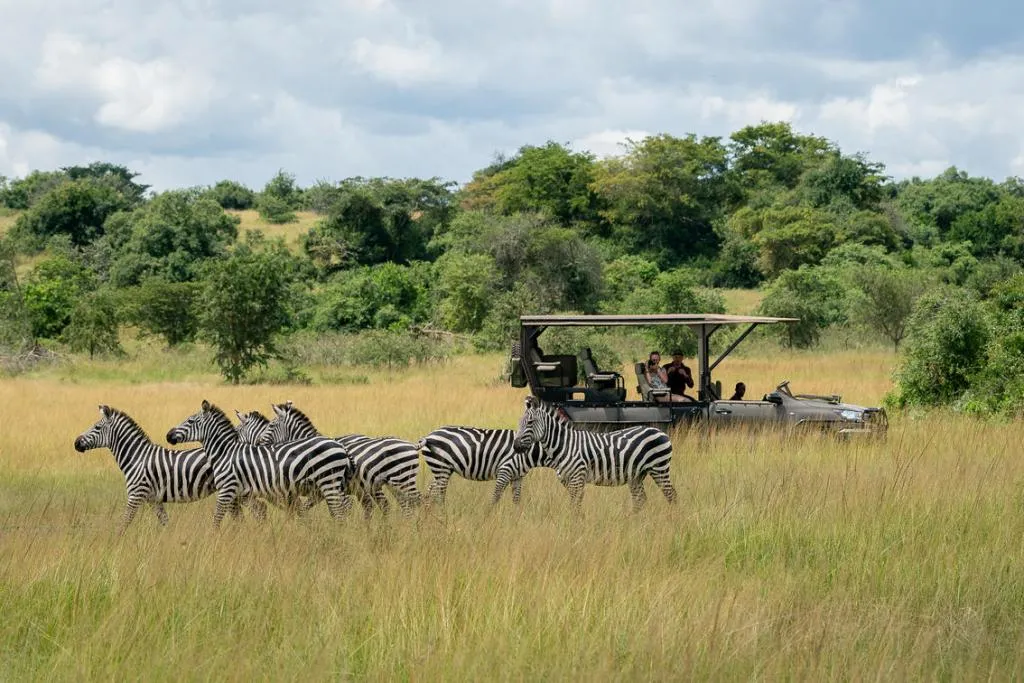
The park features a mix of naturally occurring habitats, including a valley with abundant acacia trees, grasslands, and both seasonal and permanent swamps. The park encompasses an area of 370 square kilometers. The 158 square miles of the affluent acacia tree valley of Olea and Boscia is home to almost 300 bird species and more than 68 animals. L. Mburo possesses an expansive wetland that attracts a diverse array of species, allowing tourists to observe hyenas, elands, impalas, and zebras effectively. The Finfoot and Shoebill Stork are seldom observed in other parks, although they are accessible to visitors at L. Mburo.
L. Mburo distinguishes itself from other parks by being the exclusive habitat for impala, klipspringer, and eland. L. Mburo is notable for its congregation of over 5,000 zebras, as well as the biggest populations of hyenas and leopards among Uganda’s national parks. Additional fauna observed in the open valley includes warthogs, buffalo, and reedbucks. Night game drives offer the opportunity to observe white-tailed mongooses, hyenas, bush pigs, and genets.
Lake Mburo, the principal lake in the park, is frequented by enormous crocodiles basking on its beaches and hippos quenching their thirst from its waters. Lake Mburo National Park is home to various avian species, including cormorants, pelicans, fish eagles, and herons.
Location
Lake Mburo National Park is located in the Kiruhura District within Uganda’s Western Region. It is around 30 km (19 mi) east of Mbarara district and about 240 km (150 mi) by road west of Kampala. Lake Mburo is one of the numerous national parks in Uganda that is in proximity to Kampala.
Accessing Lake Mburo National Park
Lake Mburo National Park is strategically located between Kampala, the capital city, and Mbarara, serving as a primary stopover for visitors to other parks in western Uganda. The park is accessed by road and is approximately 245 kilometers from Kampala by automobile. The journey from Kampala to L requires four hours. Mburo regarding the permissible speed limit and optimal road conditions. The drive from Entebbe to L. Mburo will require 4 hours and 20 minutes, covering a distance of 290 kilometers. The decision also hinges on whether you intend to perform step overs at Kayebwe, where the Equator is located. You may pause to explore the Mpambire market centre, renowned for its drum production.
The park’s headquarters are located in Rwonyo, 2 kilometers from the two front entrances. Consequently, whether driving from either Kampala or Mbarara, you may utilize the two gates that provide access to the park. The two gates are Sanga Gate, the first encountered when traveling from Mbarara, situated at Sanga Trading Centre, and Nshara Gate. Although there are no scheduled domestic flights within the park, arrangements can be made with Fly Uganda or Aerolink, as these are the country’s reputable domestic air carriers.
The fastest option available is to fly from Entebbe to Nyakisharara airfield in Mbarara, which will take less than an hour to reach Mbarara. From the airfield in Mbarara, one can access the park via road transportation.
It is essential to recognize that Entebbe Airport is located 46 km from Kampala; thus, it is advisable to organize for transportation and accommodations well in advance. The trip operator with whom you are communicating manages these agreements. At Arusha Car Rental, we strive to perform at our highest capability. Early arrival is beneficial for both you and your trip operator.
Best time to visit Lake Mburo National Park
Lake Mburo is accessible to visitors at any time throughout the year. The route from Kampala to the park is paved with a nice surface, as is the route from Mbarara. Wildlife observation is exceptional along the marram pathways that traverse the park.
During the wet seasons of March to May and November to December, animals are observed in greater quantities in the grazing fields and open valleys where the grass is abundant. During the arid and sunlit seasons of December to February and June to September, animals are observed visiting the water sources of marshes and lakes in quest of hydration and sustenance. Consequently, they are readily observable and visible in significant quantities. Occasionally, they can be observed around lodges that are in proximity to water holes. Consequently, they are accessible from any location.
Wildlife
Since 2005, Lake Mburo has been recognized as a habitat for impala. It is a designated conservation area for lions. The park boasts a vast array of species, including lions, deffasa waterbuck, zebras, buffalo, elands, oribis, leopards, hippos, and reedbuck hyenas. The park serves as a habitat for warthogs, impalas, common elands, jackals, hippopotamuses, African buffaloes, and African leopards. The park features a diverse array of bird species that visitors should not overlook. These encompass the renowned shoebill, African finfoot, stork, heron, pelican, Crested Crane, and more than 300 additional avian species. Rest assured, you will not overlook any of these birds or animals at the park due to its advantageous location and excellent vantage points.
Ecological system
Certainly, L. Mburo possesses an exceptional location. It possesses a dominant character and extensive ecology in the western region. The park features narrow bands of verdant, forested canyons, rugged ridges, riparian woodlands, and more landscapes. L. Mburo is home to 68 mammalian species. It does not contain lions and elephants. The absence of lions let people to navigate the park freely and approach certain animals for tactile interaction. A diverse array of birds is observed by tourists in the park, fluttering in the sky, enhancing the scenery’s appeal. Birds observable in the sky include the African finfoot, stork, heron, pelican, Crested Crane, renowned shoebill, among others.
The woods in Lake Mburo contribute to rainfall formation, which nourishes grass and provide water to animals and birds. It is advantageous for fauna and avifauna in L. Mburo is to be endowed with a forest that offers refuge for them and serves as a concealment for fauna and avifauna. The park features valleys, acacia trees, and grasslands populated with diverse grasses consumed by the wildlife therein. The park is additionally endowed with permanent and temporary marshes that facilitate the growth of papyrus. Locals utilize papyrus to create numerous artifacts, such as baskets, which sustain their livelihoods and contribute to Uganda’s economy.
Geography and Climate
L. Mburo possesses Pre-Cambrian geological formations. These rocks comprise a combination of recent completely granitized granitoids, Cenozoic Pleistocene strongly granitized rocks, and Argillite rocks from the Karagwe-Ankolean system. Argillite rocks are frequently observed in the area due to their composition, which is predominantly arenitic and silty. The park is characterized by sandy clay and sandy loam soils.
The park features various habitat types that facilitate a diversity of flora and fauna of all sizes. The habitual system is distinctive and situated in the convergence area of two biological zones. The technology aids endangered cichlid fish species that have disappeared from large lakes and other globally threatened avian species. The system facilitates impala habituation and offers refuge to 22 species of Afro-tropical and Palearctic migrating birds.
The wetland offers substantial social and economic value to individuals. Community members retrieve water for their livestock and household use. It serves for grazing and facilitates herding during arid seasons. This inhibits farmers from relocating between areas in search of pasture and water for their animals. Fish is additionally harvested from the marsh. The marshes are utilized by neighborhood members for thatching their houses.
Mburo is situated in the tropical climatic zone, similar to the other Ankole Southern climatic zones. It is situated between the rain shadow of Lake Victoria and Mount Rwenzori. The park experiences both rainy and dry seasons. During the rainy season, precipitation ranges from approximately 500 to 1000 mm. The precipitation patterns are inconsistent, resulting in insufficient grass and pastures. This compels pastoralists to seek and utilize the park. It also disrupts the behavioral patterns of avian and terrestrial creatures. The park’s temperature is expected to be between 23 and 25 degrees Celsius. Evapotranspiration in the north, northwest, northeast, and east ranges from 1450 to 1600 mm, while the south and southwest experience rates of 1300 to 1450 mm.
Activities in Lake Mburo National Park
Lake Mburo offers a diverse array of activities for visitors to partake in, allowing them to appreciate the park’s animals and natural beauty. These activities encompass boat cruises, day and night game drives, sport fishing, cultural tours, hiking and nature walks, and horseback riding. L. The natives of Mburos are the Bahima, who can be observed on natural walks and cultural experiences. The Banyankore instruct guests in the preparation of yogurt, ghee, millet, and meals such as eshabwe, which is only prepared from ghee. All these meals are available in the Igongo Cultural Centre, and a traveler should not miss the opportunity to visit and savor the exquisite cuisine. Igongo Cultural Centre is a private museum that houses information regarding the culture of Ankore.
More about these activities is detailed below.
Avifauna observation in Lake Mburo National Park.
The primary birdwatching locations at Lake Mburo are the marshy valleys, with vantage points around the salt licks and within the forested areas. Avian species observed at these sites comprise the Bateleur, Brown-chested Lapwing, Grey Crowned Crane, Rufous-bellied Heron, Black-bellied Bustard, and Coqui Francolin.
Lake Mburo features swampy valleys such as Miriti and Warukiri, which are prime birding locations, in addition to the roadsides connecting Rwonyo camp and the Jetty. Additional observation locations are situated near the salt lick in Rubanga Forest and Miriti. Bird species observed at these locations include the Common Scimitarbill, Rufous-bellied Heron, Grey Crowned Crane, Bateleur, Brown-chested Lapwing, Emerald-spotted Wood-Dove, Coqui Francolin, Brown Parrot, Red-headed Lovebird, Ross’s Turaco, Bare-faced Go-away-bird, White-headed Barbet, Long-tailed Cisticola, Red-faced Barbet, Nubian Woodpecker, Red-shouldered Cuckoo-shrike, Yellow-breasted Apalis, White-winged Tit, Finfoot, Green Wood-hoopoe, and Black-bellied Bustard, among others.
Utilizing a vehicle or traversing on foot constitutes the most convenient mode of transportation for exploring Rubanga Forest. Join us if you are an accomplished birder.
Hiking and nature excursions at Lake Mburo.
The park is accessible to all types of walkers provided they are accompanied by a ranger guide. Rubanga Forest, the salt lick at Rwonyo, the lake shores, and the hilltop offering magnificent views of the lake. Upon arriving at Rwonyo, you will be directed to a salt lick that attracts numerous creatures to the saline rocks.
Nighttime hiking in the forest gives an opportunity to observe creatures and birds. Hyenas return to their dens starting at 7 AM and require three hours. The same is true for hippos that withdraw to the lake at the same projected time. Ascending the hill allows one to observe 9 of the region’s 14.
It is advisable for walkers and birders in Rubanga Forest to make arrangements to be escorted by a ranger. All excursions must be reserved in advance.
Horseback riding in lake Mburo
Lake Mburo is a destination for equestrian riding. This is a fantastic vantage point for observing eland and buffalo. Topi, warthog, impala, zebra, duiker, waterbuck, and bushbuck are animals that are unmissable for observation. The excursion requires four hours to transport people to the mountaintop for scenic panoramas and a bush breakfast. All activities are organized at Mihingo Lodge.
Game tours in Lake Mburo
A substantial network of game trails exists in the eastern section of the park. They traverse many geographical features, including rocky outcrops, grassy slopes, ponds, acacia woodlands, and periodically inundated valley floors. The optimal times to observe wildlife are early morning and late afternoon.
During a wildlife drive in this park, one is likely to observe recently imported giraffes, warthogs, waterbuck, buffalo, zebras, and impalas. A substantial herd of elands is occasionally seen, although they are timid.
Outstanding images of the aesthetically pleasing fauna residing in the park will be captured on Safari excursions. This presents an excellent chance for all park visitors.
Nocturnal excursions in Lake Mburo
During the night, particularly from 7 PM onwards for the subsequent three hours, there is a high likelihood of observing leopards and Pottos. These nocturnal creatures are seldom observed during daylight hours but can be encountered at night during guided nocturnal excursions with a ranger.
Night drives in Lake Mburo
Lake Mburo is predominantly inhabited by tilapia, which is the most prevalent fish species, alongside four other species. Mazinga is the primary fishing location on Lake Mburo. Individuals wishing to fish in Mazinga must obtain a permit from the Uganda Wildlife Authority. If allowed, bring your own equipment.
Pause to appreciate the mosaic ecosystem comprising rocky outcrops, arid hillsides, thickets, open and wooded savannahs, shrubs, woods, swamps, and lakes, while familiarizing yourself with the diverse plant and animal species that have remained undisclosed to you until now.
Accommodation Options in Lake Mburo National Park
The lodging at Lake Mburo National Park is satisfactory and economical in comparison to other parks in East Africa. The lodges are classified into three categories: Budget lodges, Mid-range lodges, and Luxury lodges. The luxury lodges in Lake Mburo National Park are Mihingo Lodge and Lake Mburo Safari Lodge. The mid-range accommodations include Arcadia Cottages, Rwakobo Rock Lodge, and Mantana Tented Camp. The budget accommodations comprise Rwonyo Rest Camp and Eagles Nest Lodge. All lodges in the park are suitable for visitors and offer exemplary services across all categories. Lake Mburo offers luxurious accommodations at Mihingo and Lake Mburo Safari Lodge, providing unforgettable experiences.
Further information regarding these luxurious hotels is provided below;
Mihingo Lodge.
Mihingo Lodge is situated atop a hill within the park, on a rocky kopje. The lodge is built using local resources, rendering it aesthetically harmonious with the surrounding environment. The Mihingo Lodge is renowned for its exquisite and opulent swimming pool. During sunny intervals, animals are observed drinking from the water hole. The lodge can also facilitate horseback riding to enhance your wildlife viewing experience. The lodge offers nature walks in addition to several other activities, such as bush biking. The lodge guides will immerse you in the Ankore community, allowing you to comprehend the distinctiveness of Ankore culture through direct interaction. Staying at Mihingo Lodge allows for relaxation amidst nature and wildlife.
Rwakobo Rock.
Rwakobo Rock is located 1 kilometer from the Nshara Gate of L. Mburo. The lodge can accommodate eight (8) cottages, ranging from single to double to triple configurations, in addition to a family unit. Visitors at the lodge can partake in various activities. These encompass walking safaris, cycling, and nocturnal wildlife drives. The lodge staff organizes a campfire for tourists to gather and enjoy the evening. A hammock is situated near the lodge, allowing you to unwind while appreciating the captivating vista of vast plains. Animals can also be observed drinking from the watering hole adjacent to the restaurant. Rwakobo is situated outside the park, so allowing you to avoid the entrance price on your initial night of stay.
Eagle’s Nest Lodge.
Are you genuinely seeking an affordable African experience? Eagles Nest Lodge is at your service. The lodge offers an excellent vantage point in Uganda, situated on the hill adjacent to Lake Mburo. Meals at the lodge are made over a wood fire and cooked in large African potjies. Each safari tent features its own balcony overlooking the park. The park’s bathrooms provide an opportunity to explore the bush, and the toilets are environmentally friendly. Your stay at Eagle’s Nest offers a splendid outlook, showcasing wildlife and environment, all within a budget.
Mantana Tented Camp (Opulent Tent Accommodations).
This is sometimes referred to as Lake Mburo Camp. It offers opulent tented lodging within the park. The Mantana tented camp is located on the hillside of Rwamahungu. It is referred to as a hill of eagles. From the hill, one can observe the entirety of Lake Mburo and its adjacent ecosystems, which are serene and appealing. It offers opulent tents situated on expansive wooden decks, featuring beds, verandahs, and en-suite facilities that afford guests a view of Lake Mburo and the valley, accompanied by a deluxe sitting room, eating area, and bar. Resident zebras, waterbucks, warthogs, buffalo, impalas, civet cats, and other avian species are observed near the tents, attempting to relax while drinking from the neighboring waterholes within the park.
Arcadia Cottages – (Moderate Pricing)
Arcadia Cottages is situated 2 kilometers from the headquarters of Rwonyo Park. It is nearer to the lake. During the boat cruise and wildlife drives in the park, you will observe crocodiles and hippos. You will experience proximity to nature while being accompanied on the nature walk.
Arcadia Cottages comprises eight (8) self-sufficient cottages surrounding a central lodge structure. Visitors savor exquisite cuisine in the restaurant within this edifice. They may observe magnificent animals from the freshly constructed elevated deck. In the evening, patrons may enjoy a beverage in the opulent bar while others hydrate, observing impalas, hippos, and warthogs grazing few meters away.
Lake Mburo Safari Lodge – (Semi-Luxurious)
Lake Mburo Safari Lodge is situated within the park and offers semi-luxurious hotel options. The homes are constructed from wood and feature grass-covered roofs. The resort offers honeymoon suites, family cottages, luxury cottages, and a campground that is strategically located and well equipped with showers, power, and flushing toilets. Campers have the choice to either prepare their own meals or purchase food from the restaurant. Campers may either rent tents from the resort or bring their own. The campground is well drained, clearly designated, and optimally leveled.
Rwonyo Rest Camp.
Rwonyo Rest Camp is located 1 kilometer west of Saga Gate. The camp is administered by the Uganda Wildlife Authority (UWA). It provides bandas and tents, in addition to coordinating camping at Mazinga Camp Site.
Points of Interest at Lake Mburo National Park
Rwonyo Rest Camp
Upon arriving at Rwonyo Rest Camp, you will find yourself at the heart of the park’s tourism activities. Quad riding, hiking, woodland excursions, and game drives. The literature and handcrafted items available in little shops will captivate you.
Lake Mburo
Lake Mburo possesses indigenous animals and flora. The park is inhabited by various birds and animals, including hippopotamuses, crocodiles, and buffaloes. These creatures are consistently observed consuming water throughout the warm seasons. The avifauna included Cormorants, Malachite Kingfishers, African Fish Eagles, Pied Kingfishers, Rufous Long-tailed Starlings, Green-necked Doves, Blue-headed Weavers, Pelicans, Hammerkops, Herons, and the uncommon Shoebills.
Rubanga Forest
Rubanga Forest is located in the western region of Lake Mburo National Park. The woodland is elevated and features a well-designed viewing platform for guests. This area is also inhabited by several forest birds. The regularly observed bird species include the Green Pigeon, Harrier Hawk, Grey-backed Cameroptera, Narina Trogon, and Double-toothed Barbet. A ranger is consistently accessible for anybody seeking to explore the woodland.
Game Tracks
Numerous trails are situated in the eastern hinterland of Lake Mburo. A variety of avian and terrestrial species can be observed in the vicinity. From the summit, you will observe the park’s five lakes.
Safari Packages to Lake Mburo National Park
Lake Mburo’s safari packages are exhilarating and economical for holidaymakers. The park provides many types of safari packages. For instance, a 2-day Lake Mburo safari, a 3-day Lake Mburo safari, a 12-day premier Uganda wildlife expedition, among others. Lake Mburo packages are consistently combined with those of other parks, including Murchison Falls National Park, Queen Elizabeth National Park, Bwindi Impenetrable National Park, Kibale Forest National Park, among others. Lake Mburo safari packages are organized and curated by proficient and seasoned tour operators or safari firms. Consequently, it is advisable for a traveler intending to explore Lake Mburo to engage a professional safari company or tour operator.
Entry Fees for Lake Mburo National Park
Park entry fees are levies imposed on visitors for access to the park and participation in various activities within it. Some individuals consistently contend that the park’s size justifies their exemption from the entrance price. Nevertheless, a fee is required due to the diverse array of spectacular wildlife and natural beauty available for enjoyment. Note that the park features two entrances: Nshara Gate and Sanga Gate. The following information outlines the entrance price and the payment method.
At Lake Mburo National Park, the entrance cost for a Ugandan-registered saloon car is 20,000 UGX, while SUVs and 4×4 vehicles incur a tax of 30,000 UGX.
In 2018, new charge structures were proposed, and the subsequent amount was recognized. Wildlife groups were required to pay 2000 UGX, children 5000 UGX, Ugandan pupils or students 3000 UGX, university students 5000 UGX, and adults 20,000 UGX.
Foreign residents: 30 USD; adults: 40 USD for foreigners and 20,000 UGX for East African residents; children: 10 USD for foreign residents, 20 USD for foreigners, and 5,000 UGX for East Africans; tertiary institutions: 5,000 UGX; student groups: 3,000 UGX; Uganda wildlife clubs: 2,000 UGX.
The annual park entrance fee for East African residents is 15,000 Uganda shillings. Individual passes cost 350 USD, while East African residents pay 200,000 UGX and international visitors pay 500 USD. Corporate passes are priced at 2,500,000 UGX. Families, with a maximum of four children, are required to pay 300,000 UGX. Taxi drivers pay 100,000 UGX, and tour operators are charged 125,000 UGX, while tour company drivers are exempt from fees.
Lake Mburo National Park charges the following admission and landing fees: motorcycles for East African visitors are required to pay 10,000 UGX, while international visitors must pay 30 USD. Minibuses: Omni-buses were required to pay 30,000 UGX for East Africa and $50 for foreign routes. Tour company vehicle costs 30,000 UGX for East Africa and $120 for overseas travel. Pickups and 4WD vehicles are priced at 30,000 UGX for East Africa and $50 internationally.