Volcanoes National Park Rwanda
Volcanoes National Park Rwanda is Africa’s oldest national park, established in 1925 primarily to safeguard and preserve the endangered mountain gorillas. The park is referred to as Parc National Des Volcans in French and is situated near Kinigi, a small village in Musanze, formerly known as Ruhengeri, in the northwestern region of Rwanda. Volcanoes National Park in Rwanda is situated within the expansive Virunga Conservation Area, adjacent to Virunga National Park in the Democratic Republic of Congo and Mgahinga Gorilla National Park in Uganda. Volcanoes Park encompasses an area of 160 square kilometers and is renowned for its diverse biodiversity, which includes five of the nine Virunga volcanic mountains, various vegetation types, endangered mountain gorillas, golden monkeys, and animal species such as elephants, buffaloes, bushbucks, giant forest hogs, and numerous bird species.
Attractions in Volcanoes National Park
Mountain Gorillas
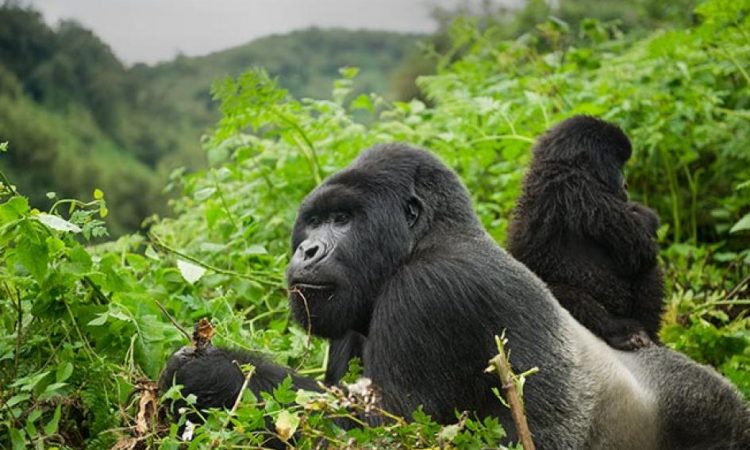
Mountain Gorillas: Volcanoes National Park is home to the endangered mountain gorillas, which are the park’s most prominent attractions. The park housed more than 14 habituated gorilla families accessible for hiking daily, including the Susa, Amahoro, Karisimbi, Sabyinyo, Agastya, Umubano, Kwitonda, Bwenge, Ugenda, Pablo, Titus, Igisha, Isimbi, and Muhoza groups.
Golden monkeys
Golden monkeys are a distinctive species found in Volcanoes National area and serve as the second most prominent attraction in the area, following gorillas. Golden monkeys are endangered primates that inhabit groups exceeding 50 individuals and mostly consume bamboo, fruits, and leaves, among other food sources. Golden monkey trekking at Volcanoes National Park is the second most popular activity, providing guests with exceptional experiences.
Birds
This national park is renowned as a birdwatcher’s paradise, housing over 300 bird species, some of which are indigenous to the Albertine Rift. Birdwatching in Volcanoes occurs in bamboo, alpine, grassland, and bushland habitats, where one can observe various avian species, including the African green broadbill, Kivu ground thrush, Rwenzori Batis, red-faced woodland warbler, paradise flycatcher, long-crested eagle, grey-throated tit, Rwenzori double-collared sunbird, strange weaver, and handsome francolin, among others.
The Virunga Volcanoes encompass five of the eight volcanoes, including Mount Muhabura at 4,127 meters, Mount Gahinga at 3,474 meters, Mount Sabyinyo at 3,634 meters, Mount Bisoke at 3,711 meters, and Mount Karisimbi at 4,507 meters above sea level.
Musanze Caves
The Musanze Caves are located within the park and were formed as a result of volcanic eruptions. The Musanze caverns are located deep within a cliff, extending 2 kilometers in length and featuring walkways and steps for human access.
The Dian Fossey Research Centre
The Dian Fossey Research Centre is an institute established by primatologist Dian Fossey to safeguard the endangered mountain gorillas in Volcanoes National Park. At the Research Centre, you may view the burial of Dian Fossey and others associated with the gorillas.
Activities done in Volcanoes National Park
Gorilla trekking:
Gorilla trekking is the predominant activity at Volcanoes National Park. Gorilla trekking is an exhilarating endeavor in which individuals aged fifteen and older venture into the forest to locate the endangered mountain gorillas, subsequently spending one hour in their natural environment upon discovery. The gorilla trekking adventure commences with a morning briefing at the park headquarters in Kinigi, outlining the expectations and regulations to adhere to while hiking in the jungle. Following the briefing, you will be organized into groups of eight based on your interests and physical fitness levels, assigned a park guide, and then commence hiking. Gorilla trekking lasts between 2 to 7 hours, contingent upon the gorillas’ location, as they frequently relocate in pursuit of sustenance.
The park is home to around 15 habituated gorilla families, of which one family, known as Hirwa, fled to Mgahinga National Park in Uganda in October 2019, leaving 14 gorilla groups remaining. Gorilla trekking in Volcanoes National Park permits a maximum of eight individuals to trek with each habituated gorilla family. Upon locating the gorillas, visitors are allowed to spend one hour observing their behaviors and habitat, as well as taking photographs, thereby providing an exceptional gorilla trekking experience during their safari.
Golden monkey trekking:
Golden monkey hiking in Volcanoes National Park is the second most popular activity behind gorilla trekking. Golden monkey trekking commences with a briefing at the park headquarters, followed by an expedition into the jungle accompanied by park guides. Trekking for golden monkeys requires less time than gorilla trekking, as golden monkeys are typically located at the foothills of Volcanoes National Park within bamboo jungle. The park contains around two habituated groups of golden monkeys, each consisting of more than 50 individuals. Upon locating the golden monkeys, guests will have the opportunity to see them for one hour as they engage in feeding, playing, and photography, among other activities.
Bird watching:
Volcanoes National Park is a haven for birdwatchers, hosting over 300 bird species, including around 16 unique to the Albertine Rift. Birdwatching in Volcanoes National Park commences in the morning with a briefing. Accompanied by a birding guide, participants will venture into the jungle to observe various avian species, including the red-faced woodland warbler, handsome francolin, Rwenzori turaco, Rwenzori Batis, strange weaver, dusky crimson wing, Rwenzori double-collared sunbird, collared Apalis, archer’s ground robin, paradise flycatcher, long-crested eagle, African marsh harrier, common moorhen, and white-tailed blue flycatcher, among others.
Dian Fossey Research Center
Dian Fossey was a primatologist dedicated to the conservation of primates, particularly mountain gorillas, which were facing extinction due to poaching. The Dian Fossey Research Centre is situated between Mount Bisoke and Mount Karisimbi. Visitors wishing to see the Research Centre and view her grave must undertake a hike lasting 3 to 5 hours.
Mountain Climbing
Volcanoes National Park include five of the eight Virunga Mountains, namely Mount Bisoke, Mount Sabyinyo, Mount Karisimbi, Mount Gahinga, and Mount Muhabura.
Mount Bisoke.
This is a dormant volcano that rises 3,711 meters above sea level. Mount Bisoke is located in the Democratic Republic of Congo and Volcanoes National Park. Ascending Mount Bisoke requires approximately 4 to 6 hours, during which one traverses Afro-Montane vegetation. At its summit, Mount Bisoke features a picturesque crater lake, alongside views of Mount Mikeno in the Democratic Republic of Congo and the presence of gorillas in the surrounding forest.
Mount Muhabura
Mount Muhabura is the second tallest peak in Volcanoes National Park, standing at 4,127 meters above sea level. Mount Muhabura is jointly located in Rwanda and Uganda, accessible for climbing from both nations. The climb lasts approximately 6 to 8 hours, and at the summit of Mount Muhabura, one will encounter a crater lake with breathtaking vistas of the surrounding landscapes, including the twin lakes Burera and Ruhondo.
Mount Karisimbi
This is the tallest volcano in the Virunga Mountain range, standing at 4,507 meters above sea level, making it the fifth highest in Africa; thus, it occasionally experiences snowfall due to its proximity to the equator. Hiking Mount Karisimbi is more arduous and demanding, hence it is advised for proficient hikers who enjoy extended treks, as it requires a full day and includes camping at the summit, resulting in a two-day adventure safari with overnight camping.
Mount Gahinga
Mount Gahinga, at an elevation of 3,474 meters above sea level, is the shortest volcanic mountain in Volcanoes National Park, catering to less ambitious climbers. Mount Gahinga is a dormant volcano located within Mgahinga Gorilla National Park in Uganda and Volcanoes National Park.
Mount Sabyinyo
Mount Sabyingo, standing at 3,634 meters above sea level, is situated between Mgahinga Gorilla National Park and Volcanoes National Park, allowing for hiking access from either side. Upon reaching the summit of Mount Sabyinyo, you will be positioned at the intersection of three countries: Uganda, Rwanda, and the Democratic Republic of Congo.
Cultural interaction:
During the cultural experience, you will visit the Ibyi’wacu cultural group located outside Volcanoes National Park in Musanze village. Ibyi’wacu cultural village provides guests with community tours that include activities such as banana beer production, local meal preparation, hunting skill acquisition, mat weaving, traditional farmhouse visits, and cultural dances, among others. The company provides performances and entertainment for visitors through dance, drama, music, storytelling, and other forms. You will have the opportunity to see the king’s palace, observe the governance of past monarchs, consult traditional healers who employed herbal remedies for various ailments, and engage with the Batwa pygmies who resided in the forest prior to its designation as a national park, among other experiences. The Ibyi’wacu cultural trip will enhance your understanding of Rwandan customs, hence providing an enriching experience while your safari in Volcanoes National Park.
Best time to visit Volcanoes National Park
Volcanoes National Park is accessible year-round, although the optimal visiting period is during the dry season, specifically from June to September and December to February. The dry season, referred to as the peak season, is characterized by reduced rainfall in Volcanoes National Park, facilitating successful activities such as gorilla trekking, golden monkey trekking, and mountain climbing due to the trails being passable and not muddy or slippery, unlike the wet season. The wet season, referred to as the low season, occurs from March to May and October to November, during which the forest experiences substantial rainfall, complicating trekking activities. The wet season is optimal for bird watching in the park, as it provides an abundance of fruits and food for avian species, allowing enthusiasts to observe many bird species, including migratory ones.
How to get to Volcanoes National park
Volcanoes National Park is situated in the northwestern region of Rwanda and is accessible via road and air transportation.
To reach Volcanoes National Park via air transport, you will fly to Kigali International Airport and subsequently go by road to Kinigi Park headquarters, which requires around a two-hour journey.
Road travel provides access to Volcanoes National Park from Bwindi Impenetrable National Park in Uganda for anyone seeking to engage in gorilla trekking in Uganda and Rwanda. To reach Volcanoes National Park from Uganda, one must drive from Bwindi Impenetrable Forest National Park across the Cyanika border to the park headquarters in Kinigi, a journey that takes approximately 3 to 4 hours.
Volcanoes National Park is the most frequented national park in Rwanda, renowned for its captivating features like as mountain gorillas and golden monkeys, which provide guests with exhilarating and indelible experiences during a Rwanda safari tour.