Road Trip Tanzania
Tanzania is one of East Africa’s most extraordinary destinations — a country of sweeping savannahs, ancient tribal cultures, snow-capped volcanic peaks, and some of the world’s most iconic wildlife reserves. Unlike flying between parks, a road trip through Tanzania gives you an unparalleled sense of the land itself: the red dust roads cutting through acacia scrubland, the Maasai herders leading cattle across open plains, the sudden appearance of giraffes silhouetted against a purple sunset.
A self-drive road trip in Tanzania is not just a mode of transport — it is the adventure itself. From the northern safari circuit connecting the Serengeti, Ngorongoro Crater, and Tarangire, to the wild southern routes threading through Ruaha and Nyerere National Parks, Tanzania rewards those willing to get off the tarmac and into the red dust with experiences money simply cannot buy.
This guide covers everything you need to plan the road trip of a lifetime: the best destinations, essential routes, what to expect on the roads, and — critically — why a 4×4 vehicle with a rooftop tent is the best possible way to experience this remarkable country.
| FAST FACTS: TANZANIA
Capital: Dodoma | Largest City: Dar es Salaam | Area: 945,087 km² | Population: ~65 million | Language: Swahili & English | Currency: Tanzanian Shilling (TZS) | Best Road Trip Season: June to October (Dry Season) |
Planning Your Tanzania Road Trip
When to Go
Tanzania has two primary seasons that dictate road conditions and wildlife viewing quality. Understanding them is crucial for planning your road trip.
Dry Season: June to October (Highly Recommended)
This is the best time for road tripping. Unpaved roads are passable, river crossings are manageable, and wildlife concentrates around permanent water sources making game viewing exceptional. The Great Wildebeest Migration in the Serengeti typically peaks between July and September, when hundreds of thousands of animals cross the Mara River.
Short Dry Season: January to February
A shorter but excellent window for road trips, particularly in southern Tanzania. Calving season in the Serengeti draws large predator activity. Roads are generally good and bush is thinner, improving wildlife sightlines.
Wet Season: March to May & November to December
Avoid road tripping in the long rains (March–May) unless you are highly experienced with off-road driving. Many unpaved roads become impassable rivers of mud, and some park roads close entirely. Short rains (November–December) are lighter and roads remain mostly accessible in the north, though caution is still advised.
| PRO TIP: Timing Your Trip
Aim for the Serengeti between July and September for the Mara River crossings. Book accommodation or designated campsites well in advance during peak season, as popular spots fill up months ahead. |
Permits, Visas, and Driving Requirements
Before you hit the road, make sure all your documentation is in order. Tanzania has specific requirements for self-drive visitors that differ depending on your nationality.
Visa Requirements
Most nationalities require a visa for Tanzania. You can obtain a single-entry tourist visa on arrival at major airports and land borders, or apply online in advance through the Tanzania Immigration Portal (recommended to avoid queues). East African Community member states — Uganda, Kenya, Rwanda, Burundi, and South Sudan — enjoy free movement under the EAC common visa arrangements.
Driving License
A valid driving license from your home country is accepted in Tanzania for a short-term visit. If your license is not in English, you will need an International Driving Permit (IDP). Always carry your license physically — a phone photo is not accepted by police checkpoints.
National Park Fees
Tanzania’s national parks are administered by TANAPA (Tanzania National Parks Authority). All fees are paid per vehicle per day, in addition to per-person conservation fees. The Ngorongoro Conservation Area has additional fees. It is strongly advised to pay these online in advance through the TANAPA online system to avoid long queues at park gates. Keep all receipts as rangers may check them inside the parks.
| PARK FEES (APPROXIMATE)
Serengeti: $70 USD/vehicle + $82 USD/adult/day | Ngorongoro: $70 USD/vehicle + $82 USD/adult + $300 USD/vehicle descent fee | Tarangire: $70 USD/vehicle + $55 USD/adult/day | Ruaha: $70 USD/vehicle + $30 USD/adult/day | Fees subject to change; always check TANAPA’s official website. |
Road Conditions in Tanzania
Tanzania’s road network ranges from excellent tarmac highways in urban corridors to challenging dirt tracks that require serious 4×4 capability. Understanding what you will face is critical.
Tarmac Roads
The A-roads and major B-roads connecting Dar es Salaam, Arusha, Moshi, Dodoma, and Mwanza are generally in good condition. The Tanzania Roads Agency (TANROADS) has invested significantly in road improvement projects in recent years. Drive carefully at night — livestock, pedestrians, and poorly lit vehicles are common hazards.
Park Roads and Bush Tracks
Inside national parks, most roads are unpaved murram (compacted earth) or corrugated gravel tracks. In the dry season, these are manageable at reduced speeds. In the wet season, they can become deeply rutted, muddy, and genuinely dangerous. High ground clearance, 4×4 drive, and locking differentials are essential. River crossings are common in parks like Ruaha and Nyerere — always assess the depth before committing.
The Infamous Corrugated Roads
Corrugation — a series of parallel ridges across the road surface — is the bane of road trippers in Tanzania. It is caused by vehicles braking on soft surfaces. The counterintuitive solution is to drive slightly faster (around 60–80 km/h), which allows your tyres to skim over the tops of the ridges rather than crash into each one. Slow driving on corrugations will shake your vehicle and all its contents apart.
| ROAD SAFETY TIP
Always carry a physical paper map or download offline maps (Maps.Me or OsmAnd) for your route. Mobile data and GPS signal can be unreliable in remote areas. Share your itinerary with someone outside the country before you depart. |
Where to Go on a Road Trip in Tanzania
Tanzania is divided into two main road trip circuits: the Northern Circuit (the most visited) and the Southern Circuit (more remote and wild). A truly epic road trip combines elements of both. Below are the must-visit destinations, organized by circuit.
The Northern Safari Circuit
Tanzania’s Northern Circuit is one of Africa’s most celebrated safari routes. Anchored by the city of Arusha, it links together some of the continent’s most famous wildlife destinations in a circuit that can be driven in as little as a week — though two weeks allows for a far richer experience.
Arusha — Your Northern Gateway
Almost every Northern Circuit road trip begins and ends in Arusha, a bustling city at the foot of Mount Meru and a five-hour drive from Nairobi, Kenya. At 1,400 metres above sea level, Arusha enjoys a pleasant climate and serves as Tanzania’s safari capital.
Spend a day in Arusha to stock up on supplies, check your vehicle, and explore the Arusha Cultural Heritage Centre and the Maasai Market for local crafts. Arusha National Park, just 25 kilometres from the city centre, offers excellent day-trip game drives and the chance to walk with giraffes.
Tarangire National Park
Located about 120 kilometres south of Arusha on good tarmac road, Tarangire is the perfect first stop on the Northern Circuit. Often overshadowed by its more famous neighbours, Tarangire is arguably the most underrated park in Tanzania.
The Tarangire River is the lifeblood of the ecosystem — in the dry season, it draws vast herds of elephants (some of the largest congregations in Africa), zebra, wildebeest, buffalo, and all of their predators. The park is also famous for its ancient, bottle-shaped baobab trees, which create one of the most dramatic and photogenic landscapes on the continent. Birdlife is exceptional, with over 550 species recorded.
- Best time to visit: June to October for elephant gatherings
- Key attraction: Elephant herds, baobab trees, lions, leopards
- Self-drive: Highly accessible with a 4×4; good network of game-drive tracks
- Stay: Multiple public and special campsites available within the park
Lake Manyara National Park
One of Tanzania’s most scenically beautiful parks, Lake Manyara lies along the base of the Great Rift Valley escarpment. The alkaline soda lake turns pink with flamingos during certain seasons, and the dense groundwater forest at the park entrance harbours troops of olive baboons, blue monkeys, and hippos.
Lake Manyara is world-famous for its tree-climbing lions — uniquely, prides here have developed the habit of resting in the forks of acacia and fig trees, a behaviour not widely seen elsewhere in Africa. The park is compact and easily explored on a half-day drive, making it an ideal stop between Tarangire and the Ngorongoro highlands.
- Best time to visit: Year-round; flamingos most abundant November to May
- Key attraction: Tree-climbing lions, flamingos, Rift Valley scenery
- Drive time from Tarangire: Approximately 1.5 hours
Ngorongoro Conservation Area
The Ngorongoro Crater is arguably the single most dramatic wildlife spectacle on earth: a massive caldera 19 kilometres across, formed when a giant volcano collapsed inward some two to three million years ago. Today, the crater floor is home to a permanent, self-contained ecosystem with approximately 30,000 large mammals, including one of Africa’s densest lion populations and a significant black rhino population.
Unlike a standard national park, the Ngorongoro Conservation Area (NCA) is a UNESCO World Heritage Site and multiple land-use area where Maasai people continue to live alongside the wildlife. The crater rim sits at approximately 2,300 metres above sea level, offering cool temperatures and cloud forest vegetation strikingly different from the plains below.
The descent into the crater is via steep, one-way tracks that require a 4×4 in low range. A separate descent and ascent track is used, and vehicles must be off the crater floor by 6:00 PM. An additional vehicle descent fee is charged on top of regular conservation area fees.
- Key attraction: Black rhino, all Big Five, dense predator concentration
- Must know: Vehicle descent fee payable at the gate; no overnight stays on crater floor
- Combine with: Olduvai Gorge (Oldupai Gorge) — the ‘Cradle of Mankind’, nearby
- Maasai culture: Authorized cultural visits to Maasai bomas available on the crater rim
| OLDUVAI GORGE (OLDUPAI)
Just 45 km from Ngorongoro gate, Olduvai Gorge is where Louis and Mary Leakey made some of the most significant palaeontological discoveries of the 20th century, including Homo habilis fossils dating back 1.9 million years. The small but fascinating on-site museum is a must-stop for anyone with even a passing interest in human origins. |
Serengeti National Park
No road trip in Tanzania is complete without the Serengeti. Tanzania’s most famous national park is also its largest, covering nearly 15,000 square kilometres of open savannah, kopjes (rocky outcrops), rivers, woodlands, and seasonal wetlands. It forms the core of the greater Serengeti-Mara ecosystem, which extends north into Kenya’s Masai Mara.
The park is defined by the Great Wildebeest Migration — the annual circular movement of over 1.5 million wildebeest, 250,000 zebra, and 500,000 gazelle in search of fresh grass and water. The migration is year-round; the animals never truly stop moving. Between July and September, they are typically in the northern Serengeti attempting the dramatic Mara River crossings, where crocodiles lie in wait and the chaos of thousands of animals plunging into the water creates some of the most extraordinary wildlife theatre on the planet.
For road trippers, the Serengeti offers a central zone (Seronera) with excellent infrastructure and game viewing, a remote northern zone (Lamai and Kogatende) for migration crossings, a wild western corridor, and a vast, barely-visited southern region. Self-drive is fully permitted and the park has numerous public campsites in addition to exclusive luxury tented camps.
- July–September: Mara River crossings in the north; best predator action
- January–March: Calving season in the south; huge cheetah and lion activity
- Year-round: Seronera Valley has the highest resident predator density
- Self-drive tip: Download the Serengeti Roads offline map before entering
| INSIDER TIP: KOPJES
The rocky outcrops scattered across the Serengeti plains (called kopjes or inselbergs) are lion, leopard, and cheetah magnets. Always slow down and scan kopjes carefully — a lion draped over a warm granite boulder can be almost invisible from a distance. |
Mount Kilimanjaro Region (Moshi)
Though most travellers come to climb Africa’s highest peak, the Moshi and Kilimanjaro region deserves attention as a road trip destination in its own right. Even if you are not trekking, driving around the base of Kilimanjaro through the lush Chagga villages, coffee farms, and banana plantations offers a profoundly different perspective from the savannah parks.
The route from Arusha to Moshi (90 kilometres on the A23) passes through the fertile foothills of Kilimanjaro. Side roads lead up into the forest zone, where you can visit cultural tourism programmes in villages like Marangu and Machame, taste freshly brewed Kilimanjaro coffee, and watch the mountain emerge dramatically from the clouds in the early morning.
Arusha National Park, though small, offers the most accessible view of both Kilimanjaro and Mount Meru and is one of the few parks in Tanzania where guided walking safaris are permitted alongside self-drive game drives.
The Southern Safari Circuit
Tanzania’s southern parks receive a fraction of the visitors that the northern circuit attracts, yet offer some of the most profound and genuinely wild safari experiences in Africa. Roads are rougher, distances are longer, and infrastructure is more limited — but for adventurous road trippers with a 4×4 and rooftop tent, the south is pure gold.
Ruaha National Park
Ruaha is Tanzania’s largest national park and, arguably, its best-kept secret. Located in the centre of the country and accessible by a long but rewarding drive from Dar es Salaam or Iringa, Ruaha is wild in the truest sense. The park is dominated by the Great Ruaha River and a maze of seasonal sand rivers, all of which concentrate extraordinary wildlife along their banks during the dry season.
Ruaha supports the largest elephant population in East Africa, with an estimated 12,000 to 14,000 individuals. It also has exceptional predator diversity — lions, leopards, cheetahs, wild dogs, and even the rare and elusive sable antelope. Because visitor numbers are so low, you may spend hours on a game drive without encountering another vehicle, creating the kind of exclusive wildlife experience that is almost impossible to find in the northern parks.
- Drive time from Dar es Salaam: Approximately 9–10 hours via Iringa
- Best time: June to October; Ruaha River and sand rivers are vital wildlife corridors
- Key species: Elephant, wild dog, lion, leopard, greater kudu, sable antelope
- Road condition: Some tracks require serious 4×4 capability, especially in wet season
Nyerere National Park (Selous Game Reserve)
The former Selous Game Reserve — recently renamed Nyerere National Park in honour of Tanzania’s founding president Julius Nyerere — is the largest protected area in Africa and a UNESCO World Heritage Site. At nearly 54,000 square kilometres, it is larger than Switzerland.
The Rufiji River system creates a network of lakes, channels, and floodplains that supports one of Africa’s greatest concentrations of hippos, crocodiles, and water birds. The park’s northern section (accessible to tourists) is excellent for game viewing, with strong populations of elephant, buffalo, lion, wild dog, and the critically endangered black rhino.
Nyerere is one of the very few parks in Africa where boat safaris, walking safaris, and fly-camping are permitted alongside conventional game drives, offering a multi-dimensional safari experience that no other single destination in Tanzania can match.
- Access: Fly-in to Msembe airstrip, or drive from Dar es Salaam (320 km via Morogoro)
- Unique activities: Boat safari on the Rufiji River, walking safaris, fly-camping
- Key attraction: Rufiji River ecosystem, wild dog packs, enormous elephant herds
- Note: A significant portion of the former reserve is now a hydropower dam project zone
Mikumi National Park
Mikumi is often described as the ‘Serengeti of the South’ — a compact but wildlife-rich park that lies directly along the TANZAM Highway connecting Dar es Salaam to Zambia. Its accessibility makes it an excellent stopping point on a road trip south, and its open floodplains provide surprisingly good game viewing, particularly for buffalo, elephant, lion, and hippo.
The park is popular with Dar es Salaam residents as a weekend destination, and its relative ease of access and good road network inside the park make it a low-stress introduction to Tanzania’s southern parks before tackling the more remote Ruaha or Nyerere.
Mahale Mountains National Park
One of Africa’s most remote and spectacular destinations, Mahale sits on the shores of Lake Tanganyika on Tanzania’s western border. Access is by light aircraft to Mahale airstrip or by a long lake journey from Kigoma, making it unsuitable as a standard road trip destination — but for adventurers extending their overland journey west, it offers the extraordinary experience of trekking in montane forests to encounter wild chimpanzees.
The Tanzanian Coast
No road trip in Tanzania is complete without heading to the coast. The Indian Ocean coastline stretches for over 800 kilometers, from the Kenyan border at Lunga Lunga in the north to the Mozambican border at Mtwara in the south, and it is lined with ancient Swahili trading towns, pristine marine reserves, coconut palms, and turquoise water.
Dar es Salaam
Tanzania’s largest city and economic capital, Dar es Salaam (‘Haven of Peace’ in Arabic), is the most common entry and exit point for road trips. It is a city of contrasts: modern office towers alongside traditional dhow workshops, high-end restaurants alongside street food stalls serving chips mayai and mishkaki grilled meat. For road trippers, Dar es Salaam is a critical logistics hub for vehicle hire, supplies, and fuel.
Bagamoyo
Just 75 kilometres north of Dar es Salaam, Bagamoyo is one of East Africa’s most historically significant towns. Once the terminus of the Arab slave trade and the most important port in East Africa, it is now a quiet town of crumbling German colonial and Arab architecture, palm-fringed beaches, and a palpable sense of history. The old town is a UNESCO World Heritage candidate and a haunting, beautiful place to spend a day.
Zanzibar Archipelago
Technically a semi-autonomous island region, Zanzibar can be reached from Dar es Salaam by ferry (crossing takes approximately two hours). While your 4×4 can be brought across on a vehicle ferry, most road trippers leave their vehicle in Dar es Salaam and take the passenger ferry to Zanzibar as a separate excursion.
Stone Town — Zanzibar’s ancient capital — is a UNESCO World Heritage Site and one of East Africa’s most atmospheric places: a labyrinth of narrow coral-stone alleyways, carved wooden doors, mosques, spice markets, and rooftop restaurants. Beyond Stone Town, Zanzibar’s beaches — particularly Nungwi, Paje, and Kendwa — rival anything the Indian Ocean has to offer.
| ZANZIBAR FERRY TIP
Fast ferries (Kilimanjaro Fast Ferries, Azam Marine) run multiple crossings daily from Dar es Salaam to Zanzibar. Book in advance, particularly during high season (July–August and December–January). The crossing takes approximately 90 minutes on a fast ferry. |
The Great Rift Valley Lakes
Tanzania’s section of the Great Rift Valley is dotted with remarkable lakes, each with its own distinctive character and wildlife.
Lake Natron
Lake Natron is one of East Africa’s most otherworldly landscapes: a vast soda lake in the shadow of the active volcano Ol Doinyo Lengai (‘Mountain of God’ in Maa), its surface shimmering in shades of red, orange, and pink from the sodium carbonate-loving micro-organisms that thrive in its caustic waters. Lake Natron is the only regular breeding site of East Africa’s lesser flamingos — up to 2.5 million birds nest here.
The road to Lake Natron from Arusha is around 200 kilometres but takes 4–5 hours due to road conditions. This is a genuine off-road experience, and a 4×4 is absolutely essential. The reward is an experience of raw volcanic African landscape that most visitors never see.
Lake Eyasi
Lake Eyasi is a shallow alkaline lake in a hot, flat-bottomed valley below the Ngorongoro highlands. It is home to the Hadzabe (or Hadza) people — one of the last hunter-gatherer communities in Africa. A guided morning with Hadzabe hunters, watching them use traditional bows and fire-making techniques, is one of the most memorable cultural experiences in Tanzania. The Datoga people, skilled metalworkers and cattle herders, also live around the lake.
Lake Victoria
Africa’s largest lake and the world’s largest tropical lake, Lake Victoria dominates northwestern Tanzania. The lakeside city of Mwanza is Tanzania’s second-largest city and a pleasant overnight stop on road trips through the northwest. Ferries connect Mwanza to the Speke Gulf and various islands. The lake is culturally central to the Sukuma people, Tanzania’s largest ethnic group.
4×4 & Rooftop Tent Tanzania: The Complete Guide
For the road tripper seeking the ultimate freedom in Tanzania, a 4×4 vehicle with a rooftop tent is the perfect combination. It places you right in the middle of the landscape — falling asleep to hyena calls and waking to birdsong — without the logistical complexity and cost of booking lodges at every stop. Here is everything you need to know.
Why a 4×4 Is Essential in Tanzania
Tanzania is not a destination where a standard two-wheel-drive vehicle will serve you well beyond the tarmac roads. The moment you enter a national park, head to a remote lake, or leave the main highway, road conditions rapidly deteriorate to levels that demand real off-road capability. A 4×4 is not a luxury — it is a necessity.
Key Reasons You Need a 4×4
- Deep sand: Common in the Serengeti, Ruaha, and coastal areas — 2WD vehicles bog down and require rescue
- River crossings: Frequent in Ruaha and Nyerere parks; depth can be unpredictable
- Steep gradients: Ngorongoro Crater descent tracks require 4×4 low range
- Mud and ruts: Even in dry season, single rain events can make tracks extremely slippery
- High ground clearance: Rocks, erosion gullies, and deep corrugations require clearance that standard vehicles lack
- Tyre punctures: Rocky tracks cause frequent punctures; carrying two spare tyres is standard practice
Choosing the Right 4×4 for Tanzania
Not all 4x4s are created equal. Tanzania’s roads demand a vehicle that combines genuine off-road capability with reliability, parts availability, and carrying capacity for camping equipment, supplies, and fuel for long-range travel.
Toyota Land Cruiser (70, 76, 78, 79 Series)
The Toyota Land Cruiser is Tanzania’s national vehicle. The 76/78/79 Series Land Cruisers are the workhorses of the African bush: bulletproof mechanically, parts are available in every town of size, and local mechanics know them intimately. If you can only hire one vehicle for Tanzania, the Land Cruiser is it. The 76 Series wagon has excellent interior space; the 79 Series double cab offers load capacity for extended camping trips.
Toyota Land Cruiser Prado (150 Series)
More comfortable than the 70 Series but slightly less capable in extreme conditions, the Prado is a popular choice for road trips that combine safari driving with tarmac travel. Well-equipped rental units typically have lift kits, aggressive all-terrain tyres, and drawer systems for camping gear. A good all-rounder for the Northern Circuit.
Toyota Hilux (Double Cab 4×4)
The Hilux is Tanzania’s most common workhorse vehicle and offers an excellent platform for a rooftop tent setup. Robust, parts-available everywhere, and easier to park in towns than a full-size Land Cruiser. Load the back with a camping drawer system and a rooftop tent for the perfect bush setup. The main limitation is interior passenger space compared to an SUV.
Land Rover Defender (New Generation)
Increasingly popular in the rental market, the new Defender 110 is exceptionally capable with its advanced terrain response system and large payload capacity. Modern Defenders hold up well in harsh conditions. The main concern is parts availability for major mechanical failures in remote areas — less of an issue on the Northern Circuit but a real concern in southern Tanzania.
| VEHICLE HIRE IN TANZANIA
Major 4×4 rental operators are based in Arusha and Dar es Salaam. Well-known operators include Base Camp Tanzania, Authentic Africa, and Nomad Tanzania. Expect to pay $150–$350 USD/day for a fully equipped self-drive 4×4 with rooftop tent, including the tent, bedding, camping kitchen, fridge, and recovery equipment. Always request a vehicle with a second spare tyre, a compressor, and a long-range fuel tank. |
Rooftop Tents in Tanzania: Everything You Need to Know
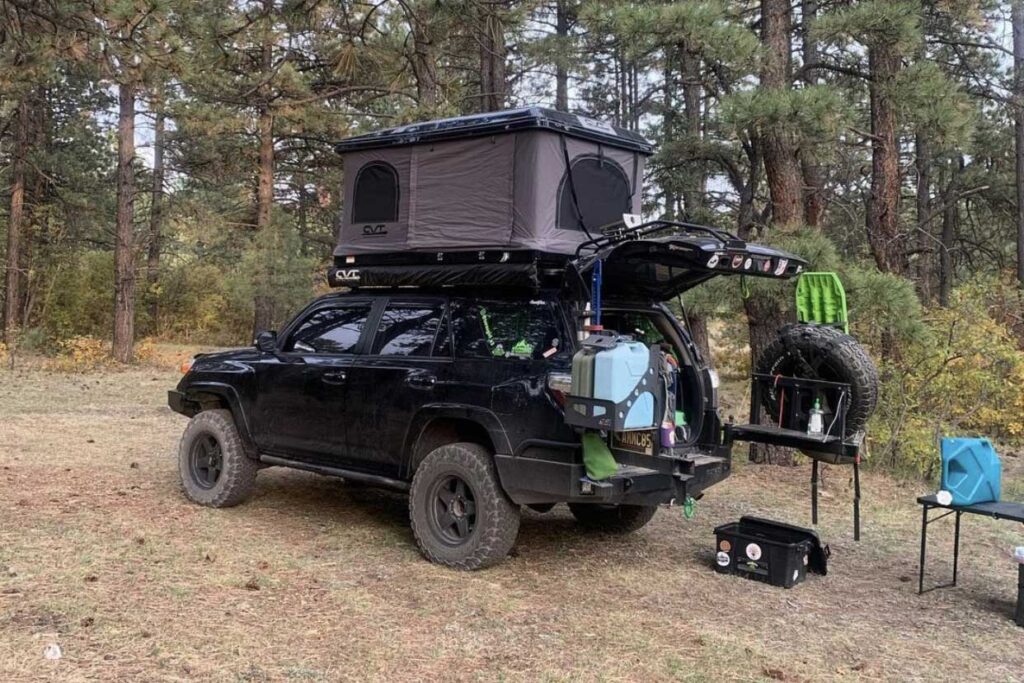
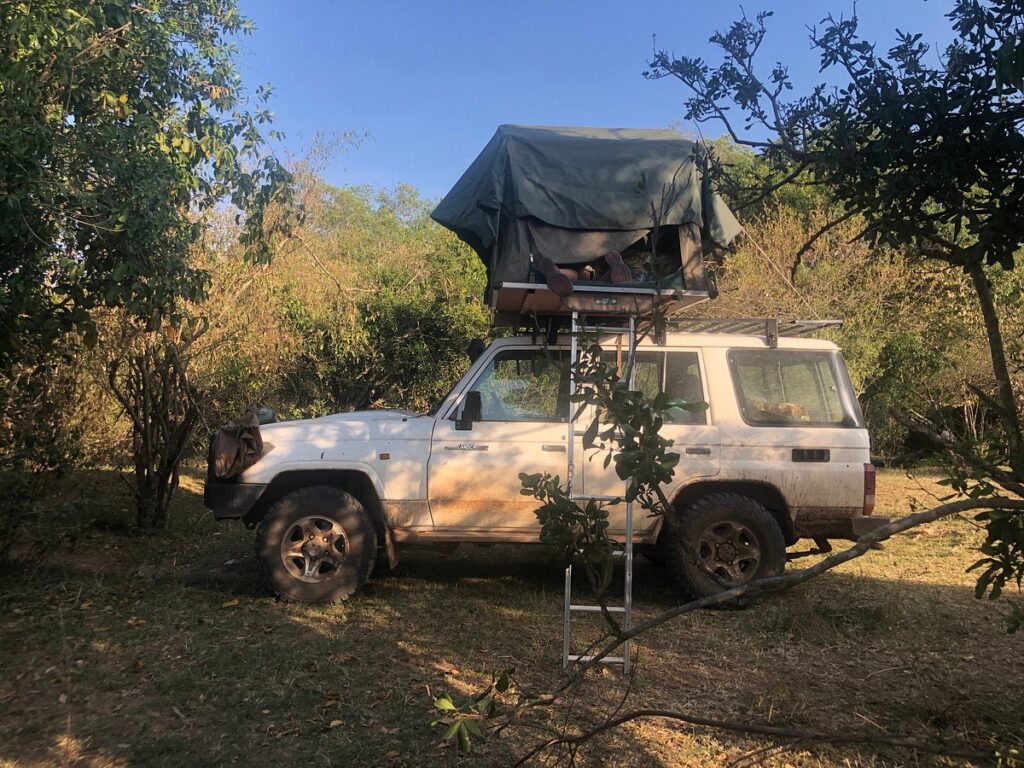
A rooftop tent (RTT) transforms your 4×4 into a fully self-contained mobile campsite. Elevated above the ground, you gain security from wildlife, a clean and comfortable sleeping surface regardless of the terrain below, and the ability to camp virtually anywhere that vehicle access exists.
Types of Rooftop Tents
Rooftop tents fall into two main categories, each with distinct advantages for Tanzania conditions.
Soft Shell Rooftop Tents
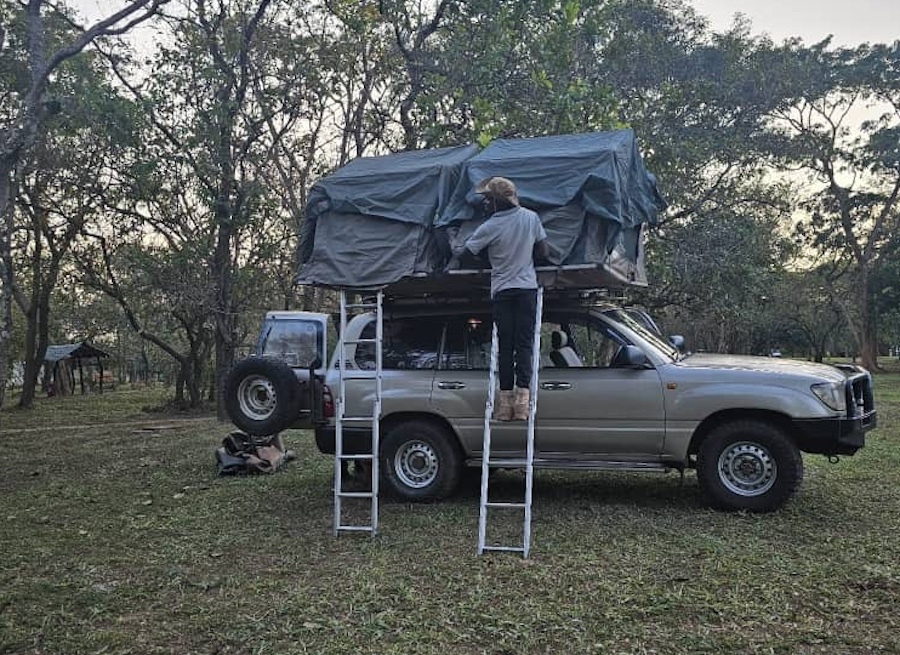
The most common type found on rental vehicles in Tanzania. Soft shell tents fold flat on the vehicle roof and open via a hinged mechanism to reveal a tent body supported by a folding ladder. They are lighter and less expensive than hard shell tents, but take slightly longer to set up (5–10 minutes) and are more susceptible to moisture penetration if not well-maintained. Brands commonly found on Tanzania rental fleets include Autohome, Eezi-Awn, and Front Runner.
Hard Shell Rooftop Tents
Hard shell tents (also called clamshell or pop-top tents) open by simply lifting the rigid shell. They set up in under 60 seconds — essential if you are driving until dark and need to camp quickly. Hard shell tents are more aerodynamic at highway speed, reducing fuel consumption significantly. They are heavier than soft shell equivalents but provide better insulation and weather protection. Popular brands include iKamper, James Baroud, and ARB. Expect to pay a premium for hard shell-equipped rentals.
| CAMPING SECURITY TIP
Rooftop tents keep you safely above most wildlife, but always zip up completely and avoid leaving food inside the tent or vehicle overnight. Hyenas in particular are notorious for investigating campsites and can easily destroy unattended food supplies and cooler boxes. |
Setting Up Camp in Tanzania
Tanzania has a well-developed public campsite network inside its national parks, administered by TANAPA. These sites range from simple clearings with a long-drop toilet to well-equipped sites with flush toilets, running water, and staffed kitchens. It is essential to book campsites in advance, particularly in peak season.
- Public Campsites: Available in all major TANAPA parks; basic facilities; lower cost
- Special Campsites: Remote, exclusive sites for single groups; no facilities; higher cost but extraordinary exclusivity
- Private Concession Campsites: Outside park boundaries on private or community land; variable facilities
- Community Campsites: Found in buffer zones outside parks; important source of income for local communities
- Wild Camping: Permitted in some areas but check locally — always ask permission from local community leaders or landowners
Essential Camping Gear for Tanzania
A well-equipped rooftop tent setup for Tanzania should include the following:
Sleeping and Shelter
- High-quality sleeping bag (lightweight down for dry season; warmer bag for Ngorongoro heights where temperatures drop near freezing)
- Sleeping mat (usually integrated into the rooftop tent)
- Extra blanket for highlands
- Tarpaulin for shade setup at camp
Kitchen and Water
- Two-burner gas camping stove and sufficient gas canisters
- Pot, pan, plates, cups, cutlery — the camping kitchen essentials
- 12V compressor fridge/freezer (a 45L Engel or ARB fridge is ideal for a two-person trip)
- 20-litre water jerry cans (minimum two) — always carry emergency water reserves
- Water purification tablets or a LifeStraw filter as backup
- Washing-up basin, biodegradable soap
Vehicle Recovery and Navigation
- Two full-size spare tyres (punctures are very common on park tracks)
- High-lift jack and sand plates (MaxTrax or similar) for sand recovery
- Portable tyre compressor / inflator
- Tow rope and D-shackles
- Basic tool kit and vehicle manual
- GPS device with Africa maps loaded offline
- Paper maps of all regions you plan to visit
Health, Safety, and Comfort
- Full first aid kit including wound closure strips, bandages, antiseptic, and blister treatment
- Malaria prophylaxis (consult your doctor before travel)
- DEET insect repellent (minimum 30% DEET) and permethrin for treating clothing
- Sunscreen (SPF50 minimum), lip balm, and quality sunglasses
- Headtorch with spare batteries for each person
- Portable power bank and solar charging panel for devices
- Satellite communicator (e.g., Garmin inReach) for remote area emergencies
| PACKING FOR ALTITUDE
Remember that the Ngorongoro Crater Rim sits at 2,300 metres and the higher flanks of Kilimanjaro even higher. Temperatures at altitude can drop to near-freezing at night even during the dry season. Pack a warm layer and a good quality sleeping bag rated to at least 5°C for Northern Circuit trips. |
Wildlife Safety When Camping in Tanzania
Camping in and around Tanzania’s national parks means sharing space with some of the world’s most formidable wildlife. Sensible precautions will keep both you and the animals safe.
General Wildlife Safety Rules
- Never leave food or scented items (toothpaste, soap, deodorant) accessible outside your vehicle at night
- Use a designated latrine or dig a cat hole at least 50 metres from camp if no facilities exist; never go to the toilet in darkness without a torch and someone standing watch
- Never walk outside your vehicle after dark in unfenced campsites in wildlife areas
- If elephants approach camp, move slowly to your vehicle and allow them space to pass
- Never approach or feed any wildlife — including baboons, which become extremely aggressive when food-conditioned
- Keep your tent zipped at all times — snakes, scorpions, and insects can enter through open mesh
- Listen to camp staff and rangers — their local knowledge of animal behaviour and recent movements is invaluable
| HYENA AWARENESS
Spotted hyenas are extremely intelligent and bold scavengers. They can and will investigate any accessible food source at night. Never leave shoes, leather items, or cooler boxes outside — hyenas have been known to carry off boots, tyres, and even vehicle door handles. If you hear hyenas near camp at night, stay in your tent. |
Fuel and Supplies on the Road
Fuel planning is one of the most critical logistical considerations for a Tanzania road trip. In national parks, there are no fuel stations, and even in remote towns outside the parks, supply can be unreliable. A long-range fuel plan is essential.
- Fuel type: Most rental 4x4s run on diesel; confirm this before driving and never put petrol in a diesel engine
- Fill up in major towns: Arusha, Moshi, Dodoma, Iringa, Mbeya, Mwanza, and Dar es Salaam have reliable fuel stations
- Carry auxiliary fuel: A long-range tank (110–130L) is ideal; alternatively carry 20L jerry cans as reserve fuel
- Serengeti crossings: The distance from Naabi Hill gate to Seronera to Ndabaka gate is over 250 km on rough roads — ensure you have sufficient fuel
- Ruaha approach: Fill up completely in Iringa before heading to Ruaha — the distance is approximately 130 km on rough road
- Nyerere/Selous approach: Fill up in Morogoro before heading south to the park
- ATMs and cash: Carry USD cash as backup; many remote areas have no ATM access and USD is widely accepted for park fees and some services
Suggested 4×4 Rooftop Tent Itineraries
Here are two suggested self-drive rooftop tent itineraries — one for the Northern Circuit and one covering both circuits for longer trips.
10-Day Northern Circuit (Arusha Based)
| Day | Location | Activity / Overnight |
| 1 | Arusha | Arrive, vehicle collection, supplies, overnight Arusha or Arusha NP campsite |
| 2 | Tarangire NP | Drive to Tarangire (2 hrs), full day game drive, overnight public campsite |
| 3 | Tarangire NP | Morning game drive; drive to Lake Manyara (1.5 hrs), afternoon game drive |
| 4 | Lake Manyara / Karatu | Morning Lake Manyara; drive up to Ngorongoro rim, overnight crater rim campsite |
| 5 | Ngorongoro Crater | Full crater descent and game drive, Olduvai Gorge visit, overnight rim camp |
| 6 | Serengeti (South) | Drive into Serengeti via Naabi Hill, afternoon game drive, Seronera campsite |
| 7 | Serengeti (Central) | Full day game drive around Seronera Valley and kopjes, overnight Seronera |
| 8 | Serengeti (North) | Drive north to Kogatende/Lamai (migration zone), afternoon Mara River viewing |
| 9 | Serengeti (North) | Full day Mara River crossing (in season) and north Serengeti game drives |
| 10 | Return to Arusha | Drive out via Naabi Hill and back to Arusha via Ngorongoro; vehicle return |
16-Day North and South Combined Circuit
| Day | Location | Activity / Overnight |
| 1–2 | Arusha / Tarangire | Arrival, supplies, Tarangire game drives and camping |
| 3–4 | Ngorongoro | Lake Manyara, crater rim camp, crater descent |
| 5–7 | Serengeti | Three days self-drive, Seronera and north Serengeti |
| 8 | Drive South | Return to Arusha/Dar es Salaam; overnight Arusha |
| 9 | Mikumi NP | Drive south on TANZAM highway; afternoon Mikumi game drive |
| 10–12 | Ruaha NP | Drive to Iringa, then Ruaha; 3 days wild game driving in Ruaha |
| 13–14 | Nyerere NP | Drive to Nyerere; boat safari on Rufiji River; walking safari |
| 15 | Dar es Salaam | Drive north to Dar es Salaam; coastal overnight |
| 16 | Zanzibar / Depart | Morning ferry to Zanzibar or return flight from Dar es Salaam |
Culture, People, and Responsible Travel
Tanzania is home to approximately 125 ethnic groups, making it one of Africa’s most ethnically diverse nations. A road trip through Tanzania is also a journey through this extraordinary human tapestry — from Maasai warriors in the north to Hadzabe hunter-gatherers around Lake Eyasi, Chagga farmers on Kilimanjaro’s slopes, and Swahili traders along the coast.
Swahili: Tanzania’s Unifying Language
Swahili (Kiswahili) is Tanzania’s national language and the first language of millions of Tanzanians, particularly in coastal regions. It is also Tanzania’s language of instruction in primary schools. Unlike in Kenya where Swahili is widely spoken but English dominates business, in Tanzania Swahili is the primary working language. Learning even a handful of Swahili phrases will transform your interactions with local people and open doors that remain closed to travellers who rely solely on English.
- Habari — Hello / How are you (general greeting)
- Nzuri — Good / Fine
- Asante sana — Thank you very much
- Karibu — Welcome / You are welcome
- Pole pole — Slowly slowly (also: take it easy — essential Tanzanian philosophy)
- Hakuna matata — No problem (yes, it is real Swahili and Tanzanians do say it)
- Shikamoo — Respectful greeting to an elder
- Marahaba — Response to Shikamoo
The Maasai People
The Maasai are perhaps East Africa’s most recognisable people — semi-nomadic pastoralists who have maintained their traditional culture with remarkable resilience in the face of modernisation. Their lands span the border between northern Tanzania and southern Kenya, encompassing much of the Serengeti ecosystem.
Maasai men are distinguished by their red ochre-stained wraps (shukas), elaborate beaded jewellery, and — for warriors (Morani) — distinctive long hair. Maasai women shave their heads and wear intricate beaded collar necklaces. Maasai bomas (homesteads) are clusters of mud-and-dung houses inside a circular thornbush fence.
Cultural visits to Maasai bomas can be arranged near Ngorongoro, Lake Manyara, and the Serengeti. Choose operators that pay directly to the community and involve authentic interaction rather than staged performances.
Responsible Travel and Conservation
Tanzania’s wildlife is under enormous pressure from human population growth, land conversion for agriculture, and poaching. As a visitor, your choices have a real impact on conservation outcomes.
- Pay all park fees: They fund ranger salaries, anti-poaching patrols, and habitat protection
- Stay on designated tracks: Off-road driving outside marked tracks is illegal in Tanzanian parks and causes severe vegetation damage
- Do not purchase wildlife products: Ivory, tortoiseshell, coral, or any product made from protected species
- Support community-based tourism: Choose operators that channel revenue to local communities
- Minimise plastic waste: Carry reusable water bottles and refuse single-use plastic bags (plastic bags are banned in Tanzania)
- Observe the ’20-metre rule’: Maintain at least 20 metres distance from all wildlife and never attempt to attract animals’ attention
- Leave no trace: Pack out all rubbish from campsites; bury human waste
Practical Information and Travel Tips
Health and Medical
Tanzania requires preparation from a health perspective. The following medical considerations are essential for any road tripper.
- Malaria: Tanzania is a high-risk malaria zone. Take prophylaxis (consult your doctor; common options include Malarone, Doxycycline, or Mefloquine), use DEET repellent, and sleep under a mosquito net where available
- Yellow Fever: Proof of Yellow Fever vaccination is required for entry if you are arriving from a country with risk of Yellow Fever transmission. Carry your vaccination certificate
- Vaccinations: Ensure you are up to date on Hepatitis A and B, Typhoid, Tetanus, and Rabies (recommended for those spending extended time outdoors)
- Water: Do not drink tap water. Use bottled water or purify water from natural sources using a filter and purification tablets
- Sun: The equatorial sun in Tanzania is extremely intense at altitude (Ngorongoro, Kilimanjaro). Wear SPF50+, a hat, and protect your eyes
- Travel insurance: Essential — ensure your policy covers emergency medical evacuation. AMREF Flying Doctors operates a medevac service across East Africa and annual membership is a worthwhile investment for extended road trips
Money and Banking
- Currency: Tanzanian Shilling (TZS); USD is widely accepted for major transactions and park fees
- ATMs: Available in Arusha, Dar es Salaam, Moshi, and other large towns; unreliable in remote areas
- Bring USD cash: Clean, newer-issue USD bills are the most useful emergency currency
- Credit cards: Accepted in larger hotels, lodges, and some petrol stations; not universally reliable
- Exchange rates: Official exchange bureaux (Forex) in towns offer better rates than hotel exchanges
Connectivity
- Mobile data: Vodacom Tanzania, Airtel Tanzania, and Tigo are the main operators. Vodacom has the broadest coverage in national parks and remote areas
- SIM cards: Easily purchased at airports and towns with a valid passport; 4G LTE available in towns and along main highways
- Coverage in parks: Limited — Seronera (Serengeti) and the Ngorongoro crater rim have some signal; Ruaha and Nyerere have very limited coverage
- Offline maps: Download Maps.Me, OsmAnd, or the Gaia GPS app with Tanzania maps before departure
Emergency Contacts
- Tanzania Tourist Police: Available in most tourist areas; dial 112 for national emergency
- AMREF Flying Doctors: +254 20 699 2299 (Nairobi base); medevac service across East Africa
- TANAPA emergency contacts: Available on the TANAPA website and at each park gate
- British High Commission Dar es Salaam: +255 22 229 0000
- US Embassy Dar es Salaam: +255 22 229 4000
- Garmin inReach / Satellite communicator: For remote areas beyond mobile coverage, a satellite communicator is the safest emergency option
Conclusion: Hit the Road
A road trip through Tanzania is not simply a holiday. It is an encounter with one of the last truly wild places on earth — a continent still largely intact, still governed by the ancient rhythms of migration, predation, drought, and renewal. When you drive your own vehicle through the Serengeti at dawn, the dust settling behind you as a lion strides across the track, or when you fall asleep in your rooftop tent to the sound of lions calling across the darkness of Ruaha, you understand why Tanzania has captivated travellers for generations.
The practicalities are manageable. The logistics can be planned. But the experiences — those are yours alone, earned mile by dusty mile across one of the world’s last great wilderness frontiers. There is no other way to travel Tanzania quite like this.