Self Drive Guide to Mgahinga Gorilla National Park
Self Drive Guide to Mgahinga Gorilla National Park: Mgahinga Gorilla National Park is the smallest park in Uganda, encompassing an area of 33.7 km². The park derives its name, Mgahinga, from the local term “Gahinga,” which refers to the heaps of volcanic stones removed from agricultural land at the base of the volcanoes. The region was initially designated as a game sanctuary by the British authority in 1930 and then established as a National Park in 1991. The park adjoins Congo and Rwanda. This park is among the rare locations globally where the endangered mountain gorillas reside.
Attractions in Mgahinga Gorilla National Park
Mgahinga Gorilla National Park hosts more than 76 mammal species, including the rare mountain gorillas, which are among the 1,004 gorillas remaining on Earth today. Additionally, the area is home to elephants, buffaloes, golden monkeys, spotted hyenas, black-fronted duikers, gigantic forest hogs, bushbuck, and over 115 bird species, as detailed below;
Mountain Gorillas:
Mountain gorillas inhabit in three countries: Uganda, Rwanda, and the Democratic Republic of the Congo. In Uganda, gorillas inhabit only two parks: Bwindi Impenetrable National Park and Mgahinga National Park.
Golden Monkeys:
These remarkable beings are classified as endangered primate species, mostly inhabiting the deep bamboo forests along the Gahinga trail, with other species peculiar to the Albertine Rift. These remarkable species can be observed during Golden monkey trekking and nature excursions.
Other Wildlife:
Mgahinga hosts more than 76 species of mammals, including bush pigs, gigantic forest hogs, forest buffaloes, elephants, bushbucks, golden cats, side-striped jackals, black-fronted duikers, and South African porcupines. Nevertheless, observing these wildlife species is challenging due to the dense forest foliage of the park; however, some can be heard in the wilderness.
Birds:
Mgahinga Gorilla National Park, as a forested area, has numerous bird species typically observed during birdwatching and nature excursions. The species include the Ibis, Pin-tailed Whydah, Speckled Mousebird, Stonechat, Grey-capped Warbler, Waxbills, Yellow-vented Bulbul, Firefinch, White-naped Raven, Black Kite, Rwenzori Turaco, Blue-headed Coucal, Paradise Flycatcher, Rwenzori Batis, Double-collared Sunbird, and Rwenzori Nightjar.
Virunga volcanoes:
This park features three Virunga peaks: Mount Sabinyo, Mount Gahinga, and Mount Muhavura. The Virunga volcano presents three formidable peaks for climbing and serves as the premier destination for hikers.
Activities in the Mgahinga Gorilla National Park
Mountain Gorillas Trekking:
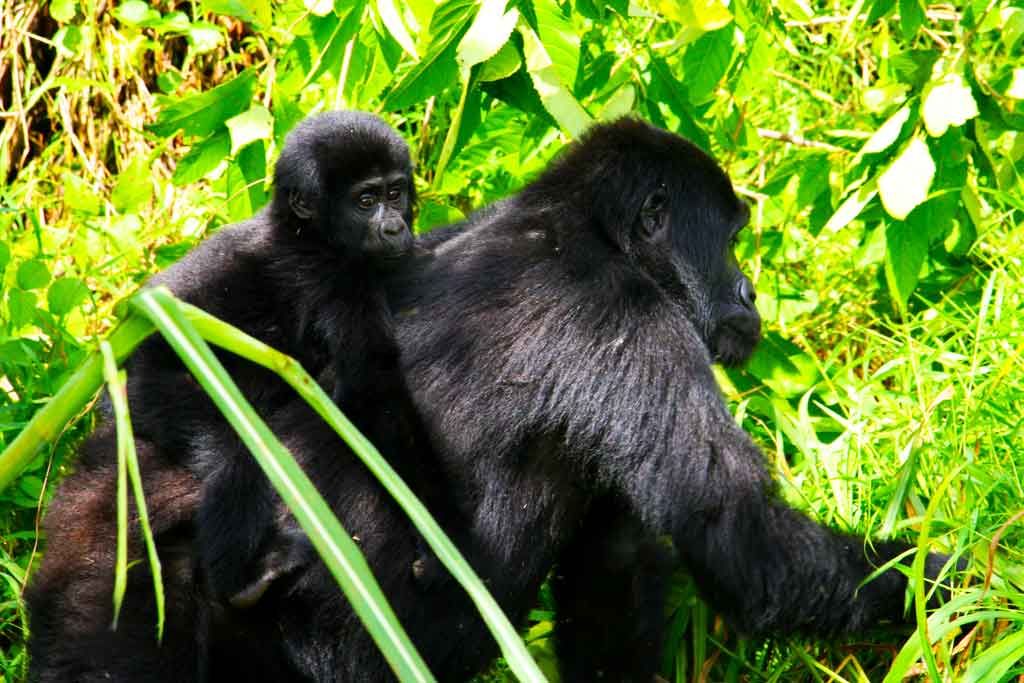
Visitors typically visit this park to trek mountain gorillas. Mountain gorillas are an endangered primate species located in Uganda, the Democratic Republic of Congo, and Rwanda. In Uganda, they are located exclusively in two National Parks: Bwindi Impenetrable National Park and Mgahinga Gorilla National Park. Mgahinga hosts a solitary habituated Nyakagezi gorilla population. This family comprises the dominant silverback Bugingo, approximately 50 years old, who is the progenitor of the majority of the group members. His silverback offspring are Mark and Marfia, alongside two blackbacks, Rukundo and Ndungutse, who enjoy posing and playing in the trees. The two females are Nshuti, the mother of Furraha, and Nyiramwiza, the mother of Nkanda. These mountain gorillas traverse the entire forest in pursuit of sustenance. Mgahinga Gorilla National Park is the premier destination for gorilla trekking in Uganda due to its dense rainforest, which hosts a diverse array of tree species, and the fact that gorillas are herbivorous. Abundant food in the park is the reason some individuals travel from Congo and Rwanda to this location. Although present in limited quantities, the gorillas of Mgahinga are readily seen in their native environments, facilitating tracking relative to other parks.
Birding:
Numerous avian species captivate visitors at Mgahinga National Park, including the black kite, white-necked raven, paradise flycatcher, double-collared sunbird, ibis, whydah, Ruwenzori nightjar, Ruwenzori turaco, dusky crimsonwing, Kivu ground thrush, yellow-vented bulbul, and waxbills, among others. Birdwatching at Mgahinga encompasses some of its most stunning landscapes, including the valley between Mount Gahinga and Sabinyo, the bamboo forest, and the montane forest, where the exquisite Rwenzori Turaco can be spotted. Birdwatchers may also utilize the Gorge trail.
The Gorge track, situated between Mount Gahinga and Mount Sabinyo, is the premier track for birdwatchers. On this walk, visitors can observe several bird species, including the Cape Robin-chat, Dusky Turtle Dove, Brown-crowned Tchagra, Kivu-ground Thrush, Olive Thrush, Bronze Sunbird, Regal Sunbird, Blue-headed Sunbird, Rwenzori Batis, Black-headed Waxbill, and Streaky Seedeater, among others.This trek may require three to four hours to complete.
Additional notable birding locations include the bamboo belt at around 2,500 meters above sea level and the elevated montane woodland at 2,660 meters. The Rwenzori Turaco is predominantly observed at approximately 2,700 meters. Along the Uganda-Congo border, in flat terrain, the Chubb’s Cisticola, Red-faced Woodland Warbler, Banded Prinia, and Doherty’s Bush-shrike are noisy yet elusive residents of the dense undergrowth at the forest’s periphery.
Mountain/Volcano Climbing:
This activity is the most exhausting, although it is worthwhile. Mgahinga National Park features three volcanic mountains, all of which are accessible for summiting by visitors. Ascending a volcano requires an entire day to attain the summit. The volcanoes comprise Mt. Sabinyo, standing at 3,669 meters, located 14 kilometers away, with a round travel duration of approximately eight hours. Visitors traverse a difficult slope to attain the summit of Mt. Gahinga, which stands at 3,474 meters and requires approximately 6 hours for a round trip. During this expedition, participants traverse the swamp-laden crater, encounter enormous lobelia, and navigate the bamboo forest, where they may observe golden monkeys, culminating at Mt. Muhavura, the highest peak at 4,127 meters. This 12-kilometer round journey requires approximately eight hours. Upon reaching the summit, trekkers are gratified with a clear vista of the Virunga Volcanoes, Lake Edward, Bwindi Impenetrable Forest, and the Rwenzori ranges.
Cultural Interactions:
During the cultural interaction, guests can engage with the Batwa who inhabit the deep forests of Mgahinga. The indigenous Batwa hunter-gatherers and formidable warriors relied on the forest for habitation, sustenance, and medicinal resources but were subsequently displaced from their environment. The Batwa guide guests through the woodlands, showcasing their ancestral dwellings and survival practices. On the Batwa Trail, tourists will explore the enchantment of the Batwa’s ancestral homeland while engaging in nature hikes and acquiring knowledge about the cultural history of this unique group.
Hiking and Nature Walk
Exploring the slopes of the Virunga Volcanoes allows tourists to observe avian species, the Rugezi Swamp, diverse flora, bamboo groves, and stunning vistas of adjacent lakes and agricultural communities. A trek through the forest to the profound Sabinyo Gorge offers excellent birdwatching prospects, where numerous avian species, including the Rwenzori Turaco, are readily observable. This trek lasts four hours and traverses the Rugezi Swamp, which is exceptional for ornithologists.
The trek to the Congo border provides guests with the chance to observe several vegetation zones. Hikers can observe the calderas atop Gisozi Hill, as well as the communities of Kisoro and Bunagana, and Lake Mutanda. Mount Gahinga, from which this volcano derives its name, refers to a mound of lava stones surrounding which agriculture is conducted. Ascending this volcano may take six hours through a bamboo forest and offers trekkers spectacular vistas. The Sabyinyo volcano, signifying “old man’s teeth,” requires approximately eight hours to ascend, making it an ideal location for anyone seeking a more arduous hiking experience. From the summit of this volcano, one can attain a panoramic view over Uganda, Rwanda, and the Democratic Republic of the Congo.
Golden monkey tracking:
Mgahinga National Park is the premier location for Golden monkey trekking. Here, gold encounters silverback. Golden monkey trekking is a unique primate expedition available in this park. Throughout this procedure, visitors have the opportunity to observe several species, including buffalo and duikers.
Your journey to Mgahinga Gorilla National Park will be remarkable as you trek with gorillas, observe golden monkeys, encounter diverse bird species, and conclude your visit with the Batwa exhibiting hunting techniques, honey gathering, medicinal plant identification, and the crafting of bamboo cups. You will thereafter advance to the revered Garama Cave, where the community’s ladies perform a moving song that reverberates through the cavern’s depths.